Northwestern University Athletics
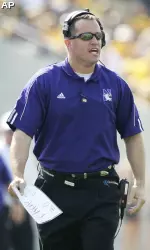
Purdue Game Program Features: Pat Fitzgerald
10/20/2008 12:00:00 AM | Football
Oct. 20, 2008
Most things in life are best when taken in moderation. Too much of a good thing, like hours beneath a hot summer sun or days on end of exercise with no rest, usually just leaves us burnt out or exhausted.
Being a head coach at the collegiate level is decidedly not something that belongs on that list. It's no secret that the lives of coaches are characterized by early mornings, late nights and weeks at a time on the road for recruiting trips. It is one of the few professions where a person is expected to redirect praise in times of success just as readily as one has to accept blame during the job's trials and tribulations. To only be moderately invested in being a head coach is to not be invested at all.
| Other Purdue Program Features |
Those that know Northwestern head football coach Pat Fitzgerald know he is the type of person likely to list those aspects of the job description as the perks. He loves football and bleeds purple. But if he had any questions about the level of investment that comes with being the CEO of a Division I football program upon stepping in after the untimely death of Randy Walker in 2006, they were erased with two bits of advice offered up by a true coaching legend, Penn State's Joe Paterno.
"I think Coach Paterno best put it into perspective for me," Fitzgerald said. "He told me on my second day as head coach to go home that night, take a dry erase marker and write `Head Coach' in the mirror. Every day you wake up and every day you go to bed you need to look at that, and that's your responsibility. You'll learn the nuances of that responsibility as you go, but that role is different than any other you've had and there is no way to be totally prepared for it."
Be that as it may, Fitzgerald appears supremely confident in what he and his squad have set out to accomplish. Two and a half years into his tenure, he seems to have figured out far more of the job's nuances than not, among them the importance of preparation, daily improvement and, above all, investment.
Fitzgerald is beginning to see the fruits of his team's labor, guiding Northwestern to its first 5-0 start since 1962, and on Dec. 9--one week after his 34th birthday--he will be formally inducted into the College Football Hall of Fame in South Bend, Ind., to honor his incredible playing career as a Wildcat.
If it all seems a bit premature for Fitzgerald, the youngest head coach in the FBS, one need only spend a few minutes listening to him address his team to realize that his presence and ability to lead go far beyond his years.
"I think hearing the way he speaks and conducts himself with the players, guys definitely get the message," said Northwestern defensive backs coach Jerry Brown, who began coaching at NU in 1993, the same year Fitzgerald arrived as a freshman. "As someone who just continued to make plays for the team, guys around him become more confident in him and it sort of sparked him to become a more vocal leader rather than just a lead-by-example type."
Fitzgerald, who grew up in Orland Park on Chicago's South Side, came to Northwestern after garnering the attention of college recruiters during his senior year at Carl Sandburg High School. During his official visits to NU, he immediately identified it as a place where he fit in, where he could contribute on the field and where he quickly bought in to head coach Gary Barnett's message of changing the attitude of the football program.
"There was a lot of unknown about the future when I was in high school but I was just hoping and dreaming to be able to play in college," Fitzgerald said. "I had a few early looks but once Northwestern came along I thought, `Wow, this might really happen' and I was just very humbled by the whole process."
Once in Evanston, he developed a close relationship with then-defensive coordinator Ron Vanderlinden, who instilled an aggressive, attacking style of play to his unit not unlike that of current Wildcats defensive head man, Mike Hankwitz.
Northwestern's defense struggled during Fitzgerald's first two years as a player but succeeded in grooming its young talent and laying the groundwork for a unit that in 1995 led the nation in scoring defense. With Fitzgerald and fellow linebacker William Bennett calling the shots, Northwestern allowed more than 20 points just one time during the regular season--during its 30-28 loss to Miami (Ohio) in week two.
"We listened to some things that were out of our control after we won at Notre Dame the first game," Fitzgerald said. "Even though we came out against Miami and took a big lead, we weren't focused on what we needed to do to win. Coach Barnett told us after that we could either be the team that beat Notre Dame or the team that lost to Miami, but either way we had to let them both go and move on. I learned a lot from those first two weeks that year."
Through Northwestern's undefeated Big Ten season, Fitzgerald and his teammates created a competitive but familial environment on the practice field that brought out the best in all of them, not unlike the 2008 edition of the Wildcats.
"We were all really close on and off the field and that showed because we stuck up for one another on the field and really played together," Fitzgerald said. "This past offseason for us was all about developing leadership and opening lines of communication to really being as competitive on the practice field as we possibly could. We're starting to see the fruits of that and we're proud of our guys."
In addition to embodying a fast, physical style of play, few collegiate linebackers entered a game more prepared to anticipate an opposing offense's next play than Fitzgerald.
"You could see he was just a film study guy," Brown said. "Here was a young guy who seemed like he had a good high school coach because he understood the importance of looking at tape."
Adam Kadela, a three-year starter at linebacker for Northwestern and 2007 team captain, had a chance to see the game through the eyes--and ears--of NU's staff when he sat out most of his sophomore season after suffering a leg injury in the third contest of the year.
"Every game I was on the headset with the coaches and really had my eyes opened to what went on between Coach Fitzgerald (then the linebackers coach) and the rest of the staff," Kadela said. "The back-and-forth discussions, talking about what the offense is doing, how to stop it, why a certain formation would leave us vulnerable. It's a huge element to the game players don't even think about and Coach Fitz is just a natural at it."
Nevertheless, the transition from player to coach requires a certain amount of change in perspective no matter how well suited a player seems to donning the headset permanently.
"Initially the biggest adjustment is not having the helmet on," Fitzgerald said. "As a player, you practice every day but you live for Saturdays whereas when you're a coach, everyday is a game day because you have to be so organized to prepare. When you're on the team you don't realize how much preparation goes into a practice, you just make sure you're on time for meetings and you go play. I developed a new respect for the sacrifices that coaches and their families make to have things organized and ready to go."
But that's not to say that Fitzgerald has forgotten those one-on-one on-field battles that characterize the game of football. For those who want a sense of how he coaches a practice, get rid of those images of head coaches who study their team from the top of a mechanical lift high in the sky while their assistants run the practice below. Instead, think of one who routinely demonstrates proper tackling form in linebacker drills, planting his players onto a blue mat on the turf.
"He can't get away from us," said senior middle linebacker Malcolm Arrington in reference to his linebacker unit. "Coach is always jumping into our drills, getting on our helmet when we make a big play and just keeping us fired up."
For such a young coach, Fitzgerald has a remarkably long list of people in his corner who'll make known his credentials for becoming the newest member of college football's Hall of Fame fraternity.
"If you're being recruited by Coach Fitzgerald to go to Northwestern, you can't help but be excited because he genuinely wants you to have the same experience he had," Kadela said. "He gets juiced just talking about it. It's a privilege for me to say he was my coach."
So far in 2008, Fitzgerald's coaching style on defense has paid enormous dividends. Under the tutelage of Fitzgerald and Hankwitz, Arrington and the rest of the NU defense entered last weekend ranked 13th nationally in scoring defense.
"I think the whole football team's attitude and approach has been great," Fitzgerald said. "I could name individuals (who are playing well) but that's not who we are. I believe we're playing well as a complete football team and that's more of our identity than anything."
Beyond that, Fitzgerald said, Northwestern's early season success reflects the on-field confidence that each player, be it a veteran or rookie, has in one another.
Which brings up that second piece of coaching wisdom that Joe Paterno shared with Fitzgerald nearly two and a half years ago--a motto which Northwestern has used as its program mantra for many years.
"Trust yourself," Fitzgerald said. "He said if he could go back to when he was a young coach, he'd probably fire himself. But he learned, he grew, he trusted himself and the people around him. I think that's important and I've tried to do my job now with that in mind."