As Scane Chases Her Scoring Record, Selena Lasota is Still Making an Impact
Austin Siegel
5/26/2023
Floating on a surfboard in the Pacific Ocean, Selena Lasota can still recognize raw athleticism when she sees it.
The student-athlete who scored more goals than anyone else in the history of Northwestern women’s lacrosse left the Wildcats more than four years ago.
But her eye for talent and remarkable drive never left Lasota.
“I’ve really gotten into the world of surfing,” she said. “It’s the hardest sport I’ve ever experienced. I’ve always picked up sports kind of quickly, but surfing is just so hard and if I’m in the water with somebody else who’s absolutely phenomenal, it’s pretty mind-blowing.”
Lasota was the Big Ten Freshman of the Year, Big Ten Attacker of the Year, a four-time All-Big Ten selection and a 2019 Tewaaraton finalist. She is still Northwestern’s all-time leading scorer.
But it was a season-ending leg injury as a junior that gave Lasota, who first stepped on campus nine years ago, an unlikely connection to Northwestern’s 2023 Final Four team.
Her last teammate still playing for the Wildcats in 2023?
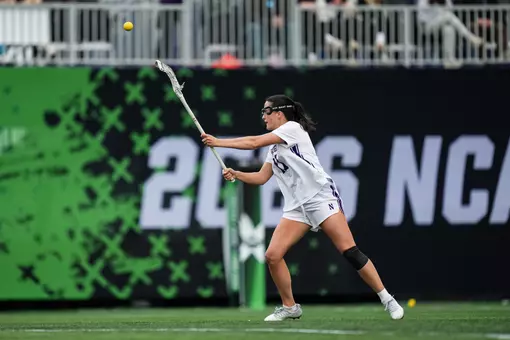
Fifth-year senior Izzy Scane, who needs ten goals at this weekend’s Final Four to break Lasota’s all-time scoring record, which has stood at 287 goals since 2019.
“I had my career at Northwestern, and I was successful, but seeing Izzy come up has made me realize there’s literally no limit,” Lasota said. “I was thinking about this after they won in the quarterfinals – maybe there will be another Northwestern player one day who is better than Izzy, but right now, I just can’t believe that.”
There are some other uncanny similarities between the two superstars. Both rebounded from season-ending injuries to become Tewaaraton finalists - Scane is nominated this season and can become the first Wildcat to win the award since Shannon Smith in 2011.
“Selena brought this energy and attitude that I really tried to emulate when I started playing at Northwestern, especially on the offensive end” Scane said. “For her to say something like that is amazing to hear because I looked up to her when I was in high school and thought she was the greatest ever. It’s an honor to be in that conversation.”
You can’t talk about impressive Northwestern debuts without mentioning Lasota and Scane.
In her first college game in 2015, Lasota helped the Wildcats engineer a seven-goal comeback against USC with four goals and the overtime game-winner at the Los Angeles Coliseum.
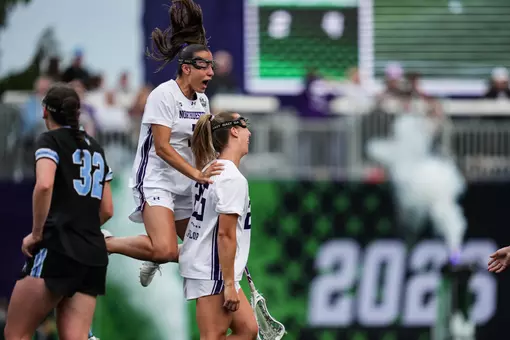
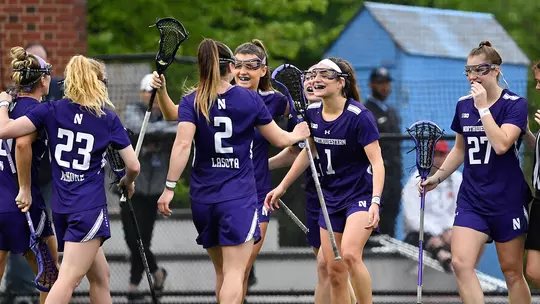
Scane scored her first goal 12 seconds into her Northwestern career, after collecting the opening draw against Louisville and racing from midfield to the eight-meter arc. The first person, literally shoving Scane in the middle of the ensuing celebration? Selena Lasota.
“I was really close to my high school coach, and he used to tell me ‘You need to go into college fearless.’ So, that’s what I tried to do,” Scane said. “I was Selena’s biggest fan in high school, so for someone like that to come in and celebrate with me was incredible.”
For anyone who followed Lasota’s career in Evanston, when she was the face of the Northwestern women’s lacrosse team, throwing herself into the hardest sport she can find might be the least surprising thing about Lasota’s second act.
Lasota is a Child and Youth Mental Health Counsellor with the Nuu-chah-nulth Tribal Council in British Columbia, a governing body that serves 15 tribes along the west coast of her home province.
Growing up on Vancouver Island as a member of the Katzie First Nation, a neighboring indigenous people, Lasota said she always wanted to help provide services like mental health counseling to the rural tribes of British Columbia.
“As a young girl, I was always involved in these indigenous communities,” she said. “I’ve had so many people influence me in my life, so I wanted to be like those counselors and social workers who came into my school. My perspective is that if I can help one person the way someone helped me, I think that would be a successful career.”
The story of Lasota’s road to Northwestern was told throughout her time in Evanston, including the short film “Homage,” produced by the Northwestern Athletic Department.
Little wonder - her journey has cinematic details to spare.
A childhood working nights on her dad’s commercial fishing boat, bringing in the catch until dawn. The early days playing box lacrosse, an indoor version of the sport, with the boys because there was no team for girls on the island. Making a ten-hour commute, including the ferry ride back and forth from the mainland, when her family moved further up the coast to Campbell River.
That journey would pale in comparison to the more than 2,000-mile trek Lasota made from British Columbia to Evanston where she began her lacrosse career at Northwestern. She felt the distance in more than just geography.
“I would write these papers about indigenous issues like the impact of colonization and colonialism and a lot of my professors - even at a great school like Northwestern - had never heard of anything like that,” Lasota said. “It was a massive change.”
It’s important context, not just to understand Lasota’s career with the Nuu-chah-nulth, but to appreciate how a teenager thousands of miles from home showed up at Northwestern in 2015, started scoring goals and just never stopped.
“I grew up watching all of these superstar Northwestern players,” Lasota said. “I came here as an 18-year-old and suddenly I’m playing at the same school as Hannah Nielsen, Taylor Thornton and Alyssa Leonard. They were the best of the best.”
The day before Scane and the Wildcats took down Loyola Maryland to clinch their spot in this weekend’s Final Four, Lasota woke up early with a boat to catch.
She was traveling to the indigenous community of Ahousaht, and Lasota would need to travel 45 minutes by water taxi in order to start her workday.
“Ahousaht First Nation are one of the only indigenous communities with their own education authority, so that’s a really cool dynamic to be a part of,” she said. “I check in with the adults at the school and poke my head into classes so I can consistently expose myself to the youth. A huge thing with my practice is building consistency in relationships.”
Lasota’s work is also grounded in the history of these indigenous communities, something she’s been conscious of throughout her career. In 2021, Lasota withdrew from the Canadian national team after the discovery of 215 unmarked graves belonging to Indigenous children at the Kamloops Indian Residential School in British Columbia.
In a statement announcing her decision, she called on the Canadian government to “acknowledge the past,” and that she would join the Haudenosaunee national team, which represents the Iroquois Confederacy, for future international competitions.
Her perspective hasn’t changed in the classroom.
“In most indigenous communities, there’s this concept of white saviorism when a non-community member wants to help, comes into the community and realizes how much grief, loss and trauma is in the community and eventually gets burnt out,” she said. “So, consistency is a huge thing for me. Having my own spiritual connection to this community is really important.”
With the Nuu-chah-nulth, Lasota is doing the same thing she did better than anyone else in the history of Northwestern Women’s Lacrosse – keep showing up, every day.
And while the Final Four won’t be televised in Canada this weekend, Lasota will be following along as the Wildcats chase their first national championship since 2012.
After all, she impacted one player on the field in North Carolina this weekend more than most.
“To be on the field with the girls, especially Selena, that I watched growing up was amazing,” Scane said. “Even though I was a young player, I had her support to play how I wanted to play.”