Northwestern University Athletics
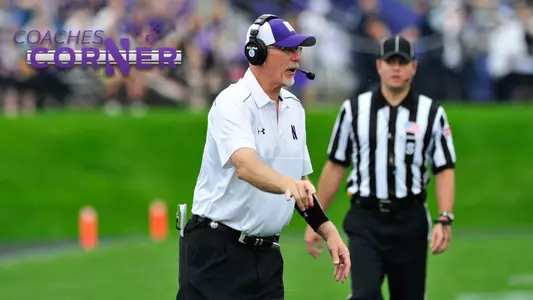
Coaches Corner: Mike Hankwitz
12/10/2015 3:45:00 PM | Football
By Skip Myslenski
NUsports.com Special Contributor
He is mere days from his 68th birthday on this December morning, and in the 45th year of a coaching career that began before Pat Fitzgerald was born. Back then, in 1970, Richard Nixon sat in the White House, the Vietnam War raged on, All in the Family debuted, the movie Woodstock premiered, dial phones were still extant and a gallon of regular gas cost 59 cents. Those now are all the stuff of memories, historical relics from a long ago past, but still he carries on, a vibrant force who this season has produced some of his finest work.
"I enjoy it," Northwestern defensive coordinator Mike Hankwitz will say when asked the obvious question of why carry on. "I like working with this age group. They're fun to work with, they're appreciative. And I still like winning, the challenge of winning. You still get the rush every week competing and playing, wanting to win. I can't see myself just sitting around doing nothing, you know. And I don't see it as work. You don't feel like-- you don't dread coming to work, you don't dread the hours. You put in hours during the season, you know. But I don't see it that way.
"It's more-- you're competing. It's still a challenge."
His dad George competed in high school and, after World War II, played on an independent basketball team that barnstormed through the western part of Michigan. He had an uncle who also competed in high school and then, during the Korean War, played basketball on his Army base team. So that gene was an innate part of him, and in full bloom by the time he reached Mason County Central High School in Scottville, MI.
"I just liked competing," he recalls, liked it so much that he did it year-round. In football his teams won three consecutive conference titles. In track he threw the shot and cleared the hurdles swiftly enough to qualify for state as a senior. In basketball, his old coach Duane Ingraham once recalled, "He was a good perimeter shooter and he was a good leaper too. He could dunk."
"Yeah. Yeah. I was in shape," Hankwitz will say with a chuckle when asked if that last fact is true.
It was in basketball, in fact, that he enjoyed his greatest high school success when his senior team qualified for the state semifinals and a trip to East Lansing. That game would go off at some nondescript gym, but if it won it, well then it would play for the championship at Michigan State's famed Jenison Field House. "It was a dream destination," Hankwitz remembers, but he would never reach it.
"We lost in overtime," he then explains, the competitor in him palpable even now. "It was extremely frustrating."
He knew there was a chance as this season approached, knew there was a chance for his defense to be special. Yes. It had suffered through a pair of bad games the year before, and had stumbled for a half against Cal and a quarter against Nebraska. But it also had produced some powerful performances, performances that hinted at what could be if only it played more consistently. "You want to show them how close we were," he says, recalling his message to his unit through last winter and spring.
"You want to show them if we do this, if we do that, it'll make a difference. They bought in and the number one factor was we had a group of seniors that was frustrated with what had happened the previous couple years and they made a commitment in January. They provided tremendous leadership, and the good part of it was we had somebody in every room. You had Dean (Lowry), Deonte (Gibson) and Max (Chapman) in the D line room, Andrew Smith was in the linebacker room, Traveon (Henry) and Nick (VanHoose) in the DB room. All those guys in different ways provided leadership through the course of winter workouts, spring practice, summer workouts."
That is why he knew his defense had a chance to be special, why too he put more pressure on himself as this season's opener with Stanford loomed. "To a degree, yeah," he will say when asked if that did happen. "You know how close you are. You want to get there."
And you don't want to screw it up?
"I told the players going into the Stanford game, 'I want to make sure I give you the best plan.' I kept thinking, 'Do I have the best plan? Do we have the right plan that we need?' Then after the game (in which they held the Cardinal to just a pair of field goals), I told them, 'Yeah, there were things that could have been better. But you guys made the plan plenty good enough the way you played, the way you approached the game.'
"That gave me confidence going forward because-- you're never going to have the perfect plan. But you want to feel you gave them enough tools to win, and they made a lot of things right."
Bump Elliott recruited him to play football for Michigan, where he was a split end as a freshman, a linebacker as a sophomore and the backup to All American tight end Jim Mandich as a junior. But then Elliott was fired and hired to replace him was Glenn Edward "Bo" Schembechler, an acolyte of the combustible Ohio State legend Woody Hayes. "He was fiery, but not in a negative way," Hankwitz remembers. "He didn't humiliate. But he'd yell at you to get the best out of you."
He yelled that spring about returning for the season in shape, and so that summer Hankwitz religiously trained for the mile run all the Wolverines would face in the fall. "He put the fear of God in you if you weren't in shape," he goes on. "It was my senior year. I was determined I was going to be in the best shape."
He would be in the best shape of them all, finishing his mile in under five minutes, and that caught the eye of Schembechler, who immediately installed him as his quick end. "I was a split end in a pro set, I was a weak side tight end in a two tight end set," Hankwitz will say, defining the position he played as Michigan rolled to a Big Ten championship and an appearance in the Rose Bowl (where it lost by seven to USC).
"Organization. The team concept," he will say when asked Schembechler's influence on him. "It was all about the team, building a team concept. I always thought their staff was great because, yeah, they were demanding, but they cared about people. They weren't dog cussing you and yelling at you to yell at you. It wasn't humiliation or anything. So I think the fact that he cared about people and had a passion for football.
"Football is the greatest team sport because it takes so many guys working together and there's no greater accomplishment than when you accomplish something as a team. That feeling of winning a championship is pretty special, you know."
His defense was special on the first Saturday of September in the 'Cats win over Stanford, and it was special still on the final Saturday of November in the win over Illinois that closed out their regular season. It had, during that season, surrendered an average of just 16.4 ppg, seventh best among the nation's 127 teams. It had, through that season, given up an average of only 310.5 ypg, 11th best among all those teams. It had, finally, put up a pass-efficiency defensive rating of 98.27, third best behind only Michigan and Wisconsin.
"But," Hankwitz says, "the thing we take greatest pride in is winning 10. It hadn't been done but two other times (in the modern era, plus a third time back in 1903 when the 'Cats victims included a pair of high schools, an alumni team and something called Chicago Dental). And this senior class did it twice. The other part is gravy, having nice defensive stats. It's about winning. Boston College led the country in total defense, but they won three games. To me it's about winning and doing something here that hadn't been done before. If we can win 11 games, the sense of accomplishment, the pride we'd feel in that. . . .
"That's why this one's a little bit special. Yeah, we had good stats. But we won 10 games."
He would work under John Harbaugh, Jim and John's dad, at Western Michigan, and under Bill McCartney and Gary Barnett at Colorado. He would work under Glenn Mason at Kansas and R.C. Slocum at Texas A&M and John Mackovic at Arizona, and each had some influence on him. ("The fun thing is you learn from everybody. Everybody is a little different personality, a little different style, and I've been blessed to have been with great people like that," he will say.) But his role model, his greatest influence was Jim Young, the defensive coordinator at Michigan when he joined that school's staff as a grad assistant in 1970. ("He is a coach. He is a teacher. I think a lot of his coaching rubbed off from Jim Young," Jack Harbaugh said of Hankwitz before the 'Cats faced the Wolverines this fall.)
He would follow Young from Ann Arbor to Arizona and then to Purdue, would eventually work under Young for a full dozen years, and it was during this time that he not only first learned about defense. For Young was an expansive thinker, an all-encompassing thinker, and so he learned too the importance of immutable truths. Be yourself. Expose yourself to different ideas. Be organized. Pay attention to detail. Be respectful. Be positive a high percentage of the time.
"Jim used quotes a lot. I like to use quotes," Hankwitz adds as well, and moments later he invokes the name of Doyt Perry, swivels in his chair and opens the drawer of a filing cabinet. From 1955 through '64 Perry coached at Bowling Green, where the stadium is named for him, and now Hankwitz pulls out two sheets of paper, the first titled, "Coaching Principles--Doyt Perry."
"We went through these every fall as a coaching staff," he then says, thinking back to his time with Young. "The amazing thing is they're just as applicable today, and these were from the '50s."
Now he starts reading those principles. "Always be fully prepared for day's work before you go on the field."
"To do a good job you must teach physical aggressiveness (toughness) as well as technique."
"The important factor is WHY and HOW not just seeing a mistake."
Then he puts the paper down and declaims, "Why did he make it? How did he make it? You don't just tell 'em, 'Hey, you screwed up.'"
Now he leans back in his chair. "Even as much as offenses and defenses have changed, these things are timeless, really," he says here. "These are the things he (Young) brought to us and as a young coach, you're reading this stuff and you're trying to incorporate it. Then he'd go to seminars with motivational people and would come into a meeting and go, 'We need to make sure we're more organized.' It wasn't in a belittling way. He was just trying to make everybody better."
And you're still that way now?
"I like to think I am. Attention to detail. Fitz says it, 'Greatness is realized through the discipline of attending to detail.' The more little things we do right, hopefully the cumulative effect of that will be positive. That's still ingrained in me"--and here he laughs--"I mean, I knew right where those (sheets of paper) were."
He is mere days from his 68th birthday on this December morning, and in the 45th year of a coaching career that began before Pat Fitzgerald was born. Already he has coached in 551 college games, 381 of them as a defensive coordinator, but now one more looms, on January 1 against Tennessee in the Outback Bowl. So still the competitor in him stirs. "Oh, yeah. I'm not going to do it if it's not," Mike Hankwitz avows, and now he is off on an emotional soliloquy that reflects his lifetime of exposures and experiences.
"I don't want to cheat anybody," he says here. "I don't want to cheat Fitz. I don't want to cheat our players. If that spark isn't there-- you put a lot of time in, you make a great investment emotionally and physically-- my biggest concern is I don't want to let anybody down. I don't want to be the guy, we didn't win because I didn't give them a good enough plan. Or I didn't work hard enough. To me that would be the worst feeling in the world. But.
"That's what I enjoy about the profession. The competition and the winning. To be able to say we did something here that hadn't been done before would be pretty darn special. It goes back to-- I played basketball in high school. I liked basketball. It's a team sport and if you don't work together, you're not going to be as good. But football, it isn't just the 11 guys on the field. You've got to have a bunch of people working together making a commitment to win a championship and do something special.
"It isn't just the starters. It's the backups that got to step in like we've had. When (linebcker) Jalen (Prater) got hurt, Nate Hall stepped in and did well. When Trav (Henry) got hurt, Terrence Brown had to step in and start against Wisconsin and did a heck of a job. (Corner) Marcus McShepard stepping in. We've had other guys step in, probably more on offense. Then the scout team. If you don't get good preparation during the week, you're not going to be ready to play in the game. Those kids bust their tails. So when you get that many people working together and making sacrifices and putting themselves behind the team part of it-- everybody would like to be playing, everybody would like to be starting. But not everybody's in that role, and it's easy to get frustrated, and then you don't have the same commitment. That's what you try to tell kids. When you do something like this, it's something you can take pride in the rest of your life because it took a lot of people to get this done.
"I've been fortunate enough to be on championship teams and have been able to go back to some of their reunions, and it isn't just the starters who come back. It's all of us. I wasn't a great player by far. I didn't contribute like my two roommates (safety Tom Curtis and Mandich). They were first team All Americans. But I take pride in being part of it. I contributed."
NUsports.com Special Contributor
He is mere days from his 68th birthday on this December morning, and in the 45th year of a coaching career that began before Pat Fitzgerald was born. Back then, in 1970, Richard Nixon sat in the White House, the Vietnam War raged on, All in the Family debuted, the movie Woodstock premiered, dial phones were still extant and a gallon of regular gas cost 59 cents. Those now are all the stuff of memories, historical relics from a long ago past, but still he carries on, a vibrant force who this season has produced some of his finest work.
"I enjoy it," Northwestern defensive coordinator Mike Hankwitz will say when asked the obvious question of why carry on. "I like working with this age group. They're fun to work with, they're appreciative. And I still like winning, the challenge of winning. You still get the rush every week competing and playing, wanting to win. I can't see myself just sitting around doing nothing, you know. And I don't see it as work. You don't feel like-- you don't dread coming to work, you don't dread the hours. You put in hours during the season, you know. But I don't see it that way.
"It's more-- you're competing. It's still a challenge."
His dad George competed in high school and, after World War II, played on an independent basketball team that barnstormed through the western part of Michigan. He had an uncle who also competed in high school and then, during the Korean War, played basketball on his Army base team. So that gene was an innate part of him, and in full bloom by the time he reached Mason County Central High School in Scottville, MI.
"I just liked competing," he recalls, liked it so much that he did it year-round. In football his teams won three consecutive conference titles. In track he threw the shot and cleared the hurdles swiftly enough to qualify for state as a senior. In basketball, his old coach Duane Ingraham once recalled, "He was a good perimeter shooter and he was a good leaper too. He could dunk."
"Yeah. Yeah. I was in shape," Hankwitz will say with a chuckle when asked if that last fact is true.
It was in basketball, in fact, that he enjoyed his greatest high school success when his senior team qualified for the state semifinals and a trip to East Lansing. That game would go off at some nondescript gym, but if it won it, well then it would play for the championship at Michigan State's famed Jenison Field House. "It was a dream destination," Hankwitz remembers, but he would never reach it.
"We lost in overtime," he then explains, the competitor in him palpable even now. "It was extremely frustrating."
He knew there was a chance as this season approached, knew there was a chance for his defense to be special. Yes. It had suffered through a pair of bad games the year before, and had stumbled for a half against Cal and a quarter against Nebraska. But it also had produced some powerful performances, performances that hinted at what could be if only it played more consistently. "You want to show them how close we were," he says, recalling his message to his unit through last winter and spring.
"You want to show them if we do this, if we do that, it'll make a difference. They bought in and the number one factor was we had a group of seniors that was frustrated with what had happened the previous couple years and they made a commitment in January. They provided tremendous leadership, and the good part of it was we had somebody in every room. You had Dean (Lowry), Deonte (Gibson) and Max (Chapman) in the D line room, Andrew Smith was in the linebacker room, Traveon (Henry) and Nick (VanHoose) in the DB room. All those guys in different ways provided leadership through the course of winter workouts, spring practice, summer workouts."
That is why he knew his defense had a chance to be special, why too he put more pressure on himself as this season's opener with Stanford loomed. "To a degree, yeah," he will say when asked if that did happen. "You know how close you are. You want to get there."
And you don't want to screw it up?
"I told the players going into the Stanford game, 'I want to make sure I give you the best plan.' I kept thinking, 'Do I have the best plan? Do we have the right plan that we need?' Then after the game (in which they held the Cardinal to just a pair of field goals), I told them, 'Yeah, there were things that could have been better. But you guys made the plan plenty good enough the way you played, the way you approached the game.'
"That gave me confidence going forward because-- you're never going to have the perfect plan. But you want to feel you gave them enough tools to win, and they made a lot of things right."
Bump Elliott recruited him to play football for Michigan, where he was a split end as a freshman, a linebacker as a sophomore and the backup to All American tight end Jim Mandich as a junior. But then Elliott was fired and hired to replace him was Glenn Edward "Bo" Schembechler, an acolyte of the combustible Ohio State legend Woody Hayes. "He was fiery, but not in a negative way," Hankwitz remembers. "He didn't humiliate. But he'd yell at you to get the best out of you."
He yelled that spring about returning for the season in shape, and so that summer Hankwitz religiously trained for the mile run all the Wolverines would face in the fall. "He put the fear of God in you if you weren't in shape," he goes on. "It was my senior year. I was determined I was going to be in the best shape."
He would be in the best shape of them all, finishing his mile in under five minutes, and that caught the eye of Schembechler, who immediately installed him as his quick end. "I was a split end in a pro set, I was a weak side tight end in a two tight end set," Hankwitz will say, defining the position he played as Michigan rolled to a Big Ten championship and an appearance in the Rose Bowl (where it lost by seven to USC).
"Organization. The team concept," he will say when asked Schembechler's influence on him. "It was all about the team, building a team concept. I always thought their staff was great because, yeah, they were demanding, but they cared about people. They weren't dog cussing you and yelling at you to yell at you. It wasn't humiliation or anything. So I think the fact that he cared about people and had a passion for football.
"Football is the greatest team sport because it takes so many guys working together and there's no greater accomplishment than when you accomplish something as a team. That feeling of winning a championship is pretty special, you know."
His defense was special on the first Saturday of September in the 'Cats win over Stanford, and it was special still on the final Saturday of November in the win over Illinois that closed out their regular season. It had, during that season, surrendered an average of just 16.4 ppg, seventh best among the nation's 127 teams. It had, through that season, given up an average of only 310.5 ypg, 11th best among all those teams. It had, finally, put up a pass-efficiency defensive rating of 98.27, third best behind only Michigan and Wisconsin.
"But," Hankwitz says, "the thing we take greatest pride in is winning 10. It hadn't been done but two other times (in the modern era, plus a third time back in 1903 when the 'Cats victims included a pair of high schools, an alumni team and something called Chicago Dental). And this senior class did it twice. The other part is gravy, having nice defensive stats. It's about winning. Boston College led the country in total defense, but they won three games. To me it's about winning and doing something here that hadn't been done before. If we can win 11 games, the sense of accomplishment, the pride we'd feel in that. . . .
"That's why this one's a little bit special. Yeah, we had good stats. But we won 10 games."
He would work under John Harbaugh, Jim and John's dad, at Western Michigan, and under Bill McCartney and Gary Barnett at Colorado. He would work under Glenn Mason at Kansas and R.C. Slocum at Texas A&M and John Mackovic at Arizona, and each had some influence on him. ("The fun thing is you learn from everybody. Everybody is a little different personality, a little different style, and I've been blessed to have been with great people like that," he will say.) But his role model, his greatest influence was Jim Young, the defensive coordinator at Michigan when he joined that school's staff as a grad assistant in 1970. ("He is a coach. He is a teacher. I think a lot of his coaching rubbed off from Jim Young," Jack Harbaugh said of Hankwitz before the 'Cats faced the Wolverines this fall.)
He would follow Young from Ann Arbor to Arizona and then to Purdue, would eventually work under Young for a full dozen years, and it was during this time that he not only first learned about defense. For Young was an expansive thinker, an all-encompassing thinker, and so he learned too the importance of immutable truths. Be yourself. Expose yourself to different ideas. Be organized. Pay attention to detail. Be respectful. Be positive a high percentage of the time.
"Jim used quotes a lot. I like to use quotes," Hankwitz adds as well, and moments later he invokes the name of Doyt Perry, swivels in his chair and opens the drawer of a filing cabinet. From 1955 through '64 Perry coached at Bowling Green, where the stadium is named for him, and now Hankwitz pulls out two sheets of paper, the first titled, "Coaching Principles--Doyt Perry."
"We went through these every fall as a coaching staff," he then says, thinking back to his time with Young. "The amazing thing is they're just as applicable today, and these were from the '50s."
Now he starts reading those principles. "Always be fully prepared for day's work before you go on the field."
"To do a good job you must teach physical aggressiveness (toughness) as well as technique."
"The important factor is WHY and HOW not just seeing a mistake."
Then he puts the paper down and declaims, "Why did he make it? How did he make it? You don't just tell 'em, 'Hey, you screwed up.'"
Now he leans back in his chair. "Even as much as offenses and defenses have changed, these things are timeless, really," he says here. "These are the things he (Young) brought to us and as a young coach, you're reading this stuff and you're trying to incorporate it. Then he'd go to seminars with motivational people and would come into a meeting and go, 'We need to make sure we're more organized.' It wasn't in a belittling way. He was just trying to make everybody better."
And you're still that way now?
"I like to think I am. Attention to detail. Fitz says it, 'Greatness is realized through the discipline of attending to detail.' The more little things we do right, hopefully the cumulative effect of that will be positive. That's still ingrained in me"--and here he laughs--"I mean, I knew right where those (sheets of paper) were."
He is mere days from his 68th birthday on this December morning, and in the 45th year of a coaching career that began before Pat Fitzgerald was born. Already he has coached in 551 college games, 381 of them as a defensive coordinator, but now one more looms, on January 1 against Tennessee in the Outback Bowl. So still the competitor in him stirs. "Oh, yeah. I'm not going to do it if it's not," Mike Hankwitz avows, and now he is off on an emotional soliloquy that reflects his lifetime of exposures and experiences.
"I don't want to cheat anybody," he says here. "I don't want to cheat Fitz. I don't want to cheat our players. If that spark isn't there-- you put a lot of time in, you make a great investment emotionally and physically-- my biggest concern is I don't want to let anybody down. I don't want to be the guy, we didn't win because I didn't give them a good enough plan. Or I didn't work hard enough. To me that would be the worst feeling in the world. But.
"That's what I enjoy about the profession. The competition and the winning. To be able to say we did something here that hadn't been done before would be pretty darn special. It goes back to-- I played basketball in high school. I liked basketball. It's a team sport and if you don't work together, you're not going to be as good. But football, it isn't just the 11 guys on the field. You've got to have a bunch of people working together making a commitment to win a championship and do something special.
"It isn't just the starters. It's the backups that got to step in like we've had. When (linebcker) Jalen (Prater) got hurt, Nate Hall stepped in and did well. When Trav (Henry) got hurt, Terrence Brown had to step in and start against Wisconsin and did a heck of a job. (Corner) Marcus McShepard stepping in. We've had other guys step in, probably more on offense. Then the scout team. If you don't get good preparation during the week, you're not going to be ready to play in the game. Those kids bust their tails. So when you get that many people working together and making sacrifices and putting themselves behind the team part of it-- everybody would like to be playing, everybody would like to be starting. But not everybody's in that role, and it's easy to get frustrated, and then you don't have the same commitment. That's what you try to tell kids. When you do something like this, it's something you can take pride in the rest of your life because it took a lot of people to get this done.
"I've been fortunate enough to be on championship teams and have been able to go back to some of their reunions, and it isn't just the starters who come back. It's all of us. I wasn't a great player by far. I didn't contribute like my two roommates (safety Tom Curtis and Mandich). They were first team All Americans. But I take pride in being part of it. I contributed."
••••••
Be the first to know what's going on with the 'Cats -- Follow @NU_Sports on Twitter, become a fan of Northwestern Athletics on Facebook, check us out on Instagram and download our mobile app from the Apple Store and Google Play! To interact directly with the #B1GCats, visit our Social Media page!


Players Mentioned

LB
/ Football
CB
/ FootballA Day in the Life with Marcus Romain | Northwestern Football
Friday, May 01
Football - Caleb Tiernan Draft Night Press Conference (4/24/26)
Saturday, April 25
Jerry Neuheisel MIC'D UP | Northwestern Football
Friday, April 10
Football - Players Pro Day Media Availability (Beerntsen, Stone, Tiernan)
Tuesday, March 17