Northwestern University Athletics
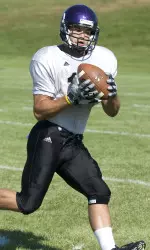
Jeremy Ebert Has Something to Prove, Again
9/1/2010 12:00:00 AM | Football
Sept. 1, 2010
By Skip Myslenski
NUsports.com Special Contributor
Oh, yeah. He heard it. Believe that he heard it. He heard it and digested it and tucked it away as safely as some amulet he could call on continually for strength and support and stimulation. It didn't matter that his name popped up on All-This-and-That teams, or that he directed his school on a rare journey deep into the playoffs, or that he put up numbers garish enough to outdo even the most outrageous outfit donned by Lady Gaga. Even then he still heard it, heard, he remembers, "Everybody saying you're not good enough, you're not fast enough. So you've always got a little something. I've got a chip on my shoulder."
That is the frank admission of 'Cat wide receiver Jeremy Ebert and so, minutes later, his position coach is asked if that trait is obvious in the way he performs. "Chip? He does (have one). He does," Kevin Johns readily replies. "I think that's the way he approaches everything. He was a five-foot-eleven high school quarterback who everyone said was too short. I think he's out to prove everyone wrong. So, yeah. He attacks everything that way. The same way Zeke (Markshausen) did a year ago. I think he had something to prove as well."
• • • • • •
When the 'Cats viewed those tapes of Ebert as a high school quarterback, Johns is saying, they saw an exceptional athlete who could run and lead and change directions. Even then, he goes on, they imagined him at wide receiver and that belief grew even stronger when he attended their camp before his senior season and showed that he could both run routes and catch the ball as well. "That," concludes Johns, "confirmed everything for us. From there it was a no-brainer."
Even as a callow (and true) freshman Ebert reconfirmed that faith, ending that '08 season with 15 catches for a pair of touchdowns as the 'Cats made their way to the Alamo Bowl. But then, in the off-season, he underwent hip surgery and suddenly, not unexpectedly, his development stalled and all the promise he showed remained just that. Promise.
• • • • • •
Pat Fitzgerald, the 'Cat coach, missed the 1996 Rose Bowl after breaking his leg late in the '95 season and so he well knows the cornucopia of effects caused by a serious injury. "When you're hurt," he says, "you're in the valley. You feel alone. You feel like nobody understands what you're going through. Then you start to get healthy, you start to come out of that valley, and you're rusty and you're out of shape and you're not very good. Then you get to where the trainers release you and you're full go, now you really start to question your ability because, again, at the end of the day you're rusty, you're not playing the way you're capable of. So it's a process to come back."
Isn't part of the process also learning to trust the damaged area?
"For me, personally, it wasn't in Kenosha. It was probably week three when I got cut again and rolled up in a pile and nothing happened. It wasn't until then I could finally feel, 'Yeah, I can cut it loose again.' So I think it's more the fear factor of re-injuring yourself than it is the injury."
Did he see Ebert go through that process?
"You lose that development in your lower body and football is so much played from your midriff down. So when your legs go, everything goes. He's definitely in a different place than he was in the past."
It wasn't psychological for him then?
"I think that was part of it. Absolutely. But I think anytime you have an injury, lower body, it's going to take you a full year to get back because you just can't train. I remember. I should have red shirted. You just don't train your legs. You don't squat. You don't hang clean. You don't condition the same way."
• • • • • •
"It was just a nagging injury, the hip, and I was never able to go full go," Jeremy Ebert is saying. "Once it started to feel right, I could play football the way I like to play it. Fast. Ever since then, it's been pretty good."
When did that happen?
"It took time. Scar tissue. It took some time."
Was the problem strictly physical, or was it psychological too?
"Yeah. Not trusting it in-and-out of breaks. Being a receiver, you're using your hips a lot more than you think. So I think that was part of it. But I'm all over it now. I'm good to go."
How hard is that process Fitzgerald talked about?
"It's real difficult. It's like a block in your mind where you don't know if you can do it. Then you start easing into it and (after) a couple workouts, you start feeling it come back. Then you've just got to cut it loose."
Does he trust it now?
"If I didn't trust it, I wouldn't be starting right now. I wouldn't be in the position I'm in. The hip's really out of my mind. It's not on my mind at all. Being 100 percent, it's a whole new world."
• • • • • •
Last season, as he worked his way through the process, Jeremy Ebert started just four games and caught a mere 21 balls. He, clearly, was not whole. But in the spring he showed flashes of his old self and then during the summer, he remembers, his speed resurfaced and suddenly he was again topping his teammates in their conditioning sprints. (He ran a 4.3 40 in high school, he says.)
Now, as the 'Cats await their opener Saturday at Vanderbilt, he appears poised on the precipice of a breakout season, a season where he replaces Markshausen as their most prolific wide receiver. He and quarterback Dan Persa, who often worked together last fall on the scout team, already possess that symbiotic relationship that defines the best of passing duos, and with his speed Ebert could well prove even more dangerous than his illustrious predecessor.
"Jeremy's a really good athlete, a really good athlete, and he's developed himself into being a great wide receiver," says Johns. "When he showed up his freshman year, there were a lot of things he didn't know about playing the position just because he was a high school quarterback. But. . .he's really worked over the last couple years watching film and watching the older guys and perfecting his game. I think the game has slowed down for him from a mental standpoint and now he understands what's going on."
What's his strength?
"A lot like Zeke Markshausen a year ago, he'll catch anything that's in his radius. As a wide receiver coach that makes me feels great, knowing that you're putting a receiver out there that will catch anything in his frame."
Can he be the new Zeke?
"If Jeremy can match what Zeke did, I'll be pretty excited."
• • • • • •
Does Ebert have a distinguishing characteristic, we ask Fitzgerald.
"Yeah. I think it's his personality," he says. "He played quarterback. His dad's an athletic director. He's dealt with some adversity. He's truly unflappable."
"I try to keep things fun, keep them energized, and I've always got a little smirk on my face," Ebert himself says when asked about his personality. "I've got a little attitude when I play, I guess. I've got a little chip on my shoulder from being a quarterback."
"That's an edge I don't think he'll ever lose. I sort of like him with that edge," Johns will soon conclude. "And to be honest with you, everyone in our receiving group attacks it that way. We're a group that doesn't get a ton of respect, so everyday we're out to prove something."
• • • • • •
Check out the full Skip Myslenski NUsports.com Archive!
••••••
Be the first to know what's going on with the 'Cats -- Follow @NU_Sports on Twitter and become a fan of Northwestern Athletics on Facebook! Get the latest news, schedule updates, video and interact with NU. For more information on following specific Northwestern teams online, visit our Social Media page!