Northwestern University Athletics
Northwestern Holds Practice, Luncheon at Naval Station Great Lakes
8/23/2010 12:00:00 AM | Football
Aug. 23, 2010


By Skip Myslenski
NUsports.com Special Contributor
NORTH CHICAGO, Ill. -- The connection reaches back to Oct. 26, 1918, that afternoon the 'Cats first played football against Naval Station Great Lakes. Their game that day ended in a 0-0 tie and the 'Cats would go on to finish 2-2-1 and unranked. But the Bluejackets, as Great Lakes was known, would fare far better.
They would end their regular season 5-0-2 and ranked No. 1, which sent them winging on to face the Marines of Mare Island of California in the fifth Tournament East-West Football Game. That is what the Rose Bowl was then called and there, in Pasadena, they romped to a 17-0 victory behind a pair of heroes. The first was their quarterback, John Leo "Paddy" Driscoll, a College Football Hall of Fame member, who had been born in Evanston, who had played for the 'Cats (1915 and '16) and who would later go on to both star for and coach the Bears.
The other was the founder of the Bears, George Halas his own self, who caught a 32-yard scoring pass from Driscoll and returned an interception 77 yards before getting dragged down at the three. That remains the longest non-scoring interception return in Rose Bowl history, a dubious honor. Still, despite coming up those few yards short, Halas would be named the game's Most Valuable Player.
• • • • • •
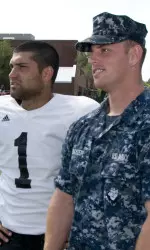
The current 'Cats stopped at Great Lakes on their way home from Camp Kenosha and there, under Monday's bright sky, they practiced a parking lot away from the field where the Bluejackets once played. Part of the reason was to call attention to their Sept. 11 home opener against Illinois State, which has been designated as Heroes' Day and will include appearances by Great Lakes' personnel.
But, certainly, there was more at work here. "There's obviously a tremendous football tradition here. . .through two world wars," said 'Cat coach Pat Fitzgerald. "To come out here and be able to participate and really be the last college team to be out here since the '40s was a real neat experience."
"We're celebrating our centennial next year, 1911 was when Great Lakes was officially commissioned, and in looking to the next 100 years, we're also looking back at our heritage and tradition and we have a wonderful tradition of football here. . .," said Captain John Malfitano, the commanding officer of Great Lakes. "We played right over there at Ross Field, which is adjacent to those buildings there, and they used to bring grandstands out and have over 20,000 young sailors there watching the games. . .
"So obviously there's that history, that tradition. But also, during World War II, the Secretary of the Navy, Frank Knox, obviously with all the combat going on, how do you train the youth for military operations? He drew a very distinct bond between those things that might make a good football player with the spiritual ethos and warrior spirit that goes into making a good sailor or soldier." Knox, in fact, felt that bond so strongly that he is quoted in an Great Lakes' Bulletin from that era as saying, "(T)his is a war where you kill or get killed! And I don't know anything that better prepares a man for bodily contact, including war, than the kind of training we get on the football field."
• • • • • •
Great Lakes played football that one season during World War I and then from 1942 through 1945 during (and after) World War II. Their first coach during those latter years was Lieutenant Commander Paul D. Hinkle, who was known as Tony and is the namesake for Butler's famed Hinkle Fieldhouse. In 1944 he was succeeded as the Football Officer of the Naval Training Center, as the position was called, by Lieutenant (jg) Paul E. Brown, who would give his name to Cleveland's professional football team and end up in the NFL Hall of Fame.
In 1942 the Bluejackets finished 8-3-1 and a year later they defeated No. 1 and previously-undefeated Notre Dame on their way to a 10-2 record. In their first season under Brown they went 8-2 and finished 17th in the polls and even in '45, despite players mustering out following VE and VJ days, they went 6-3-1. That last team, in fact, gives a measure of the talent that once graced this place.
Their quarterback was George Terlep, who a year earlier had played that position at Notre Dame. Their best running back was an obscure kid from Nevada named Marion Motley, who would go on to star under Brown on the NFL champion Cleveland Browns. Another of their runners was Grover Klemmer, a former track and backfield star at Cal-Berkeley, and the last of them was Frank Aschenbrenner, who after the war would play for the 'Cats (he was second-team All Big Ten in '48). There was also one more name on that team that would gain fame and it belonged to an 18-year old end named Bud Grant, who would mature into an All-American at Minnesota and then coach the Vikings in the Super Bowl.
• • • • • •
The sailors gathered in small groups to watch the 'Cats practice, which was cut through on occasion by other sailors who shouted out cadence as they marched. One of those was a group of Special Ops, some of whom would soon be dealing with bombs far more dangerous than those thrown by Dan Persa.
Reality, then, was inescapable on this morning, just as it is always inescapable for the 'Cat linebacker Bryce McNaul. "Austin McNaul. Second lieutenant Austin McNaul. He's an Army Ranger down at Fort Polk, Louisiana," he says, speaking of his brother and explaining just why this is so. "He's a platoon leader there. He'll be deploying in October to Afghanistan."
Does that give special significance to practicing at the naval base?
"Absolutely. I think, if you asked him, he'd say he's living vicariously through me. I'm doing the same with him. So to be able to come here and give back to these people in uniform, for me it's a tremendous honor doing what we can to help them out. So many of our people overseas and at home here in uniform watch us so intently and they get so much out of the great American tradition of college football. To be able to contribute to that, and knowing that people like my brother are able to take so much joy out of that, it's just a tremendous honor and privilege."
Does he think about his brother going over?
"I think about it all the time, every single day. The gravity of what he's doing is not lost on me at all. It gives me tremendous perspective. We come out here, we're playing a game. Yeah, it's war. It's man versus man. But his game, the game that he plays, swallows up everything. That's certainly not lost on me or my teammates or the coaching staff. We have a tremendous amount of pride in our Armed Forces and we're very patriotic and we realize what great sacrifices they're making so we can go out and do what we do."
Does that give him a greater sense of urgency?
"Absolutely. For my brother, me playing college football is almost like him having his dream come true too. Having been injured in the past, for me it's kind of like a now-or-never season and so, yeah, the urgency is definitely up for me. I want to go out and perform especially knowing that his eyes are on me and, like I said, that he gets so much pride and joy from what I do. It just pushes me on. It's definitely an incentive and it's not any type of pressure."
• • • • • •
The 'Cats last played Great Lakes on Oct. 7, 1944 and were swamped, 25-0, by the then-sixth-ranked team in the nation. But still, even in that ignominious defeat, they got a glimpse of what would be their brighter future in the person of 5-foot-9 1/2, 187-pound Bluejacket back out of Akron University. His name was Ara Parseghian.
••••••
Be the first to know what's going on with the 'Cats -- Follow @NU_Sports on Twitter and become a fan of Northwestern Athletics on Facebook! Get the latest news, schedule updates, video and interact with NU. For more information on following specific Northwestern teams online, visit our Social Media page!