Northwestern University Athletics
ON THE RECORD...With Drake Dunsmore
11/2/2009 12:00:00 AM | Football
Nov. 2, 2009
He showed promise as a freshman, but then, even before the 'Cats departed for their 2008 training camp in Kenosha, he tore up his knee so badly he would be forced to sit out the season. Now he is not only back. He is also, to the surprise of many, an integral part of his team's offense. Travel with him down the long road to recovery that led to his emergence as superback Drake Dunsmore talks with NUsports.com special contributor Skip Myslenski. . .
ON THE RECORD. . .With Drake Dunsmore
It was right out here on the practice field.
It was the fifth day of practice. We were just getting full pads. We were going to interior, which is just a run drill.
I was blocking outside zone. I went out to an outside linebacker, engaged a block, put my right foot down on the ground like I have a hundred-thousand times and for some reason, well, I can see it in my head.
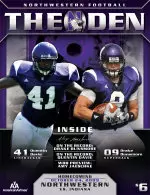
| Also in this issue... |
I heard something pop. I could hear it, I could feel it, just dropped straight down, grabbing my knee, screaming. I knew exactly what happened.
It was just a freak thing.
You watch it on film, the trainers have watched it on film, I've watched it on film, the coaches did, nobody could tell. You couldn't see it. It was just a freak thing.
It was like hearing a rope snap. You can't actually hear it. But you know when you feel something, your senses put that in your head.
It didn't hurt too bad. But I felt something pop and it was reaction to grab my knee and go down.
I just knew. When you hear something pop in your knee, it's never a good thing. Nothing good can come out of it.
I was thinking, "Please don't be a ligament." I was hoping that maybe it was just cartilage, something that wouldn't require surgery. I was praying it wasn't going to be a season-ending injury.
It was an ACL tear with meniscus damage.
I gave myself two or three days to sulk over it, feel bad for myself. After that, it was all positive, move forward, get the surgery, start rehabbing right away, get off crutches as fast as possible. It was always set little goals ahead of time to progress and keep a positive attitude.
I was really excited to play last year with those seniors we had. I had made some good bonds with those guys. When you go down for a season, a whole season, you know you're not going to get back to play with them, it's really hard to handle. That was my first hurdle.
Like I said, I gave myself a few days. After those days were up, it was all about moving forward.
I spoke to my father (Pat) quite a bit. He played and had been through a lot of injuries. He knew the right advice to give me.
He tore his MCL. Now you tear an MCL and there's no surgery required. You just take a few weeks off. So he had knee surgery, he had pulled muscles, a separated shoulder. He had his fair share.
He really kept me out of the game. Family rule for me and my brother, no football until high school.
He actually didn't start playing football until his senior year of high school. He was a basketball player and he got hurt playing basketball and said, "What the hell? If I can get hurt playing basketball, I can play anything."
He went out for the football team his senior year, got a scholarship to Drake University and from there he went on to play for the Bears.
He's got the big Super Bowl ring. He was on the '85 Bears.
His kind of view on it was football's a sport where you've got to want to be on the field and you've got to want to kill the guy in front of you. When you're a middle school kid, you can't go out there with that mentality.
His main thing was take it one day at a time. You can't think too far ahead of time. You can't think, "Oh, am I going to be back for spring ball?" Or, "What's it going to be like next season? Am I still going to be thinking about it? Am I going to be a step slower?"
Take it one day at a time and get better every day.
I talked to my coaches too, teammates.
Everyone in the locker room has had an injury. It's just a matter of when and how bad.
My first serious injury was my left shoulder, my labrum. I hurt that my freshman year. I had surgery after the season. It wasn't quite as bad. I was in a sling for a little bit. But it wasn't quite as serious as a rehab process.
A typical day of rehab (for my leg) usually took about an hour-and-a-half.
It started out pretty slow because I was on crutches for about three weeks and I couldn't move my leg. All I could do was move my leg about 45 degrees every day. So I would pull with a towel and move my leg. That's all I could do.
Once that three weeks was up, that's when the painful part of rehab came into play.
They had to bend my leg as far as they could. I was trying to get my range of motion back and they were trying to break up all the scar tissue. So every day they'd get a trainer, put me on my back and just crunch it down.
You could feel the scar tissue break.
I'd put a towel in my mouth and just cringe as they had at it. That was probably the worst part of rehab, just getting the range of motion back.
It took probably about a month. Every day.
I did some pool stuff, a lot of biking. Once you get your range of motion back, it's all downhill from there.
Then it's just monotonous.
When you're getting your range of motion back, you can see progress everyday. You can actually feel the range of motion coming back. When you're done with that, like I said, it's really monotonous. You're doing the same thing everyday.
Every two weeks, you might add a new exercise.
That's the tough part, doing it everyday and working as hard as you can and not letting yourself slack. That was the hardest part.
I've thought about it, what it would have been like if I wasn't in this team setting, if I wasn't around these guys and the coaches every day? I still came to practice, still came to meetings.
I can't imagine how unmotivated you'd be.
I can't imagine what it would be like away from that setting. It would be all on your shoulders. That's miserable.
You can't get down around all these guys because they've all been through it, the coaches and the players. So you're constantly motivated by everyone around you. That's a testament to them.
I wasn't back for spring. I had a broken foot.
Came back, first day back. In fact, I had shook the doctor's hand for the last time and, having cleared everything, was doing workouts, doing a drill, just running around, my foot snapped.
That was another hurdle to get over. That was tough. Bad luck.
It wasn't something that needed surgery. I was thankful for that.
I was able to get in the weight room more and get some bulk. I came in here pretty small.
I was back doing running workouts in the summer. I was able to get some confidence in my knee, get my speed back, get my legs back under me.
I was back on the field for the first time a year later.
For me, that broken foot was almost a blessing in disguise. I think if I had come back for spring ball, it would have been a lot harder. My knee wasn't as strong as it was for fall camp, I hadn't been running as much, and I feel I would have been rushing into things a little too fast.
Coming back in fall camp, a year had gone by.
You get cleared at six months. I'd taken double that. So coming back, I think it was a lot easier as far as getting used to cutting on the leg again. It took a few weeks for me to get used to that.
I've known some guys who had ACL injuries and, at one point, they've had to say, "Screw it" (and let it rip). I don't know that I really had that trouble because of the time.
Come to think of it, there was a play, I think it was a corner, and I cut off of it and it felt real funny. There was a sharp pain. It freaked me out. I was mentally shut down for the rest of practice because I was scared about it.
I went in, the trainers did their whole thing of shaking the knee and testing all the ligaments, and they said, "You're perfectly fine. It's 100 percent."
I was like, "It's 100 percent. Nothing's wrong with it. Nothing's going to happen."
That was in Kenosha.
After that, I knew my leg was fine. But I had some injuries before that and my biggest hurdle was just not thinking about getting another injury, just saying, "If it's going to happen, it's going to happen. I can't stop that."
Preseason camp, for me, I was almost on the level of some of the freshmen coming in. It had been so long since I had run these plays.
You can see them written on a board, memorize them, but it's not the same when you go out on a field. Seeing people in front of you, knowing the distance you've got to run, knowing the angle you've got to take to block somebody, knowing whether you can chop on this play or whether you've got to stay up--all that stuff, the more reps you take, the more natural it becomes.
The toughest thing was, along with thinking about injuries, trying not to get hurt, then thinking about what the play was and where I had to be, it makes you slower. You're a step behind everyone.
I had to get to the point where the plays were instinctual and I wasn't worrying about my legs going out or breaking a foot or tearing a knee up. Once I got to that point, I was good to play.
Coming to realize that took awhile. That took a long time.
Even after the first game, there was still something going through my head. It took that long.
Once I was able to get over that, I think I was finally over all the injuries. I'm good now.
I told my dad after the game, I had to pinch myself when I was out there for the first time. I'd been wanting it for so long. It was something I had been dreaming about, getting back on the field. To finally be out there, it was kind of surreal. It was awesome.
I've always heard it called the H-back position.
For me, it's the same position I played in high school. We were a spread team, but we used a tight end on the line every once in awhile.
It's someone who can come in and you're either on the ball or off the ball but right next to the tackle. You're blocking power. You're blocking outside zone, inside zone. Then you can also split out and block from there or run routes and catch the ball.
That's what they told me I'd be playing.
At that point, they weren't really utilizing that position. But they said they were trying new things and integrating that position into the offense more and more.
When I first got here, we were much more involved in the run game than we were in the passing game. It was very rare to see us split out.
That's what we always joked about. Everyone wanted to see that. Everyone would go crazy if they put it in the game plan. But they really didn't my freshman year.
It's definitely evolved into getting the big guys, tight ends like Brendan Mitchell and Josh Rooks and myself and Woody (Mark Woodsum), split out and into mismatches with the defense.
A linebacker or safety.
Both have their advantages (for him). A safety is usually a lot smaller and a linebacker is usually a lot bigger and stiffer and easier to use speed on.
I know, and everyone in the locker room knows, the coaches are going to put the best players out there. They're going to use them in the game plan week-to-week.
It was all about us proving ourselves to ourselves first, that we could be out there with the wide receivers doing what they do, run routes, and could still be in the line blocking.
I'm not surprised. I knew we could do it. It was just a matter of proving it to the coaches and the rest of the team. I think we've done that.
The way they're using me this year, I think I've been really blessed being able to get over the injuries and get back on the field and to not have lost a step from two years ago.
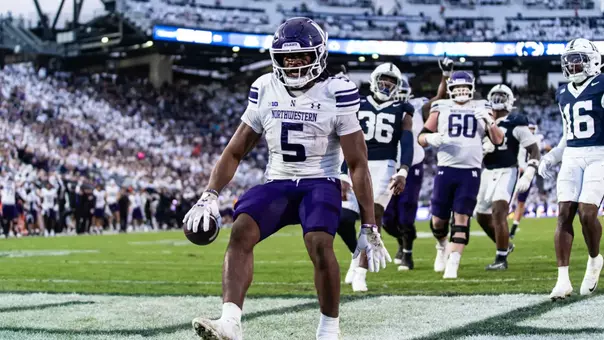
My first touchdown was during the Syracuse game. I didn't know what to do. I just kind of jumped up and thought, "What just happened?" It was the first time I'd done it.
Hopefully I'll get a couple more.
For me, originally, I got hurt in camp. So the first thing I kept telling myself was, "Just make it to Kenosha." The first time I didn't make it to Kenosha. Then I made it to Kenosha and I'm like, "You've just got to make it to the first game." Finally I made it to the first game. After that, I was like, "What am I doing? Just go out and have fun. Stop worrying about the next game or making it to this point."
If God wills me to be injured, I can't do anything about that.
I'm finally letting it loose.
• • • • • •
Check out the full Skip Myslenski NUsports.com Archive!