Northwestern University Athletics
NCAA Honors Northwestern's Role in Basketball History
3/7/2006 12:00:00 AM | Men's Basketball
March 7, 2006
Written by Kyle Adams
Media Services Student Intern
EVANSTON, Ill. -- Start by subtracting the hype, the television cameras, the throng of reporters and the thousands of fans at this year's NCAA Basketball Championship in the RCA Dome in Indianapolis. Then jump back 67 years and head over to Northwestern University. That's where the madness began.
 Front entrance of Patten Gym.  |
As the NCAA celebrates its centennial anniversary a panel of college and university presidents, athletic directors, NCAA committee members, conference office representatives, SAAC representatives and NCAA staff have named the first men's basketball championship one of the 25 Most Defining Moments in NCAA History.
The 25 moments will air on ESPN Classic and ESPNU and will be featured during the year-long Centennial Celebration on the NCAA website.
The tournament has come a long way, but when Oregon won the first championship, few thought the culmination of the eight-team tournament could be a lasting popular let alone profitable enterprise.
In fact, that first championship, which pulled 5,500 fans, lost $2,531 and the idea of a nationwide tournament was about to fade into the annals of history until the NCAA financed the National Association of Basketball Coaches' deficit and took over the tournament according to an article written by Kay Hawes of the NCAA News.
Three coaches played leading roles in founding the tournament. Ohio State coach Harold Olsen (whose team ironically ended up in the championship game) came up with the idea after seeing the success of the NIT and National Association of Intercollegiate Athletics (NAIA) tournament according to a 1982 Marty Mule article in the Eugene Register-Guard. Stanford coach John Bunn and Kansas coach Forrest "Phog" Allen also contributed.
One of the statues in front of Patten Gym.
A Different Scope

Structurally, the tournament was a far cry from the 65-team maze it is today. That first tournament was divided into eight districts. A selection committee of three or four coaches, journalists or business leaders from each district selected one team to represent their region, according to the NCAA.
The first eight participants in an NCAA basketball tournament were Brown, Villanova, Wake Forest, Ohio State, Oklahoma, Texas, Utah State and Oregon.
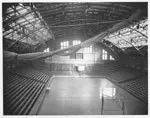
They consolidated the games into an East Regional and a West Regional. The opening rounds were played in Philadelphia and San Francisco and the winners of the two regions matched up in the championship game at Patten Gym.
In the East Regional, Villanova defeated Brown 42-30 and Ohio State defeated Wake Forest 64-52. Ohio State handled Villanova in the East Regional final 53-36 to advance to the championship game.
In the West, Oklahoma defeated Utah State 50-39 and Oregon defeated Texas 56-41. Oregon advanced to the national finals after a 55-37 victory over Oklahoma.
An indoor track and field event in Patten Gym.
Back To Campus

It might seem odd that even the inaugural tournament founders selected Northwestern as the site of the championship. Nestled in the northern suburbs of Chicago, the school lies outside the realm of exposure a big city environment provides. The NIT was played in the bustle of New York City while the NAIA tournament was held in Kansas City.
According to a 1989 article by Mike Kiley, though, Olsen was influenced by the success of the NIT, he didn't like the idea of playing college games in the city. Instead, he wanted college campuses to host their championships, an idea that was pushed by the wayside as the commercial and mainstream appeal of the tournament grew.
Still, in many ways the tournament was built around the ideal of the purity of college athletics.
Today, any casual sports fan or even a patron of popular culture can see the contrast between today's tournament and the setting for Oregon and Ohio State's title matchup almost 70 years ago.
While Olsen would certainly take issue with the pervasive commercialism in major college athletics today, it's impossible to say whether he would be better able to reconcile his opposition to the commercialization of the game in the face of its popular and financial success.
Patten Gym History
 James Patten, Former Evanston mayor |
Architect George W. Maher, who designed Patten's home and Swift Hall on Northwestern's campus, joined the project to design the gym.
Positioned on Sheridan Road, the original Patten Gym housed a baseball and track practice field on its east side, a basketball floor that was placed overtop the field, and a swimming pool.
 The swimming pool in Patten Gym. |
While the 1939 championship game was the most notable sporting event held in Patten Gym, the venue also hosted the school's annual commencement ceremony, dances, auto shows, theater productions, the Northwestern Circus and political rallies featuring the likes of Warren G. Harding and William Howard Taft.
The Oregon-Ohio State championship game was one of the last events to be held at the original Patten Gym.
It was demolished on April 1, 1940 to facilitate the construction of Northwestern's Technological Institute. The current Patten Gym, dedicated on November 2, 1940, is located a few blocks north of the old location. Though it shares little in terms of architectural style with its predecessor, it sits behind the two statues designed by artist Hermon MacNeil that adorned the entrance of original gym.
The New Era
It's a simple coincidence that the inventor of basketball, James Naismith, died in Lawrence, Kansas the same year as the inaugural tournament, but it adds symbolic value to the notion that the purity of peach basket basketball may have ended on that March day in 1939 in Patten Gym. Not right away, of course. The tournament still had a long way to go before it accrued mainstream popularity. It had even farther to go before Olsen's anti-commercial ideals were shattered. Television got in the mix in 1946 when CBS broadcast the championship to a local New York City audience of about 500,000 according to the NCAA.
Still, the first NCAA basketball championship began the process by which the sport would find itself dealing with the goods and ills that accompany mainstream success. This year, thousands will travel to Indianapolis for the NCAA Men's Basketball Championship. The Patten Gym where it all started has been gone for 66 years.
It's funny how some things start so simply.