Northwestern University Athletics
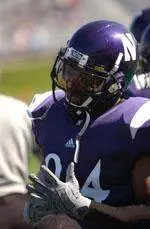
Louis Ayeni: Never Give Up
9/18/2003 12:00:00 AM | Football
Sept. 13, 2003
EVANSTON, Ill. - Former Michigan State head football coach Duffy Daugherty once said, "Football is not a contact sport, it's a collision sport. Dancing is a contact sport." Much like the phrase 'where there is smoke, there is fire' one could make a parallel claim that 'where there is football, there is injury'. If there is one person on the Northwestern roster who knows that, it is Louis Ayeni.
After a stellar high school career at Woodbury High School in Woodbury Minnesota-- one in which Ayeni was named first team all-state at running back by every publication in the state, MVP of the state championship game and a bevy of other accolades-- Ayeni surprised most recruiting analysts by choosing to play at Northwestern. The reason he headed to Evanston: a chance to play running back, and play early.
He was able to do just that. As a true freshman, he rushed for 168 yards the backup to all-Big Ten and current Arizona Cardinal running back Damien Anderson, but started on the special teams and racked up a team-high 295 yards on kickoff returns.
For the most part, Ayeni's goal of being the feature back in the NU offense seemed on track. He was on the field as a freshman, showing off what made him one of the top high school backs in the nation. Most importantly, he was on the field, a place he would not see much of in the next few years.
Heading into spring practice in 2000, Ayeni was still second on the depth chart behind Anderson, but was closing the gap between the two backs with his ability to make defenders miss. However, he was slowed by what he considered merely a 'nagging pain' in his hip. The nagging pain turned out to be a stress fracture in his hip. Ayeni was forced to sit out the first six games of the 2000 season. Unfortunately, though, that was only the first chapter of Ayeni's injury-ridden book.
Despite the six-game absence, head coach Randy Walker could ill-afford to keep such a gifted player off the field much longer and Ayeni found himself standing underneath the opening kickoff in the Alamo Bowl against Nebraska. However, Ayeni did not find himself standing anywhere for very much longer. After being tackled on the 25 yard line by a Nebraska defender, Ayeni attempted to hop up from the Alamo Dome turf like he had done after any other tackle, but something was terribly wrong.
"Being a running back, your first instinct is to get up immediately, but I had a hard time getting up. Honestly, I don't know how I got off the field."
It would the last time Ayeni was on the field for close to 20 months. When it was all said and done, the play had left him with a broken fibula, a chipped tibia, and three torn ligaments in his ankle-it had also left him wondering why.
"After my whole ankle injury, I started to feel like the coaches had just written me off. When you are playing, you kind of notice how coaches treat injured players. And then when I was out that year, I realized that I was one of those players," Ayeni said. "At a point, you really just start wondering why all of this is happening."
Despite suffering an injury severe enough to cause many players to leave the game completely, Ayeni knew that he was blessed with too much talent to simply walk away. The ankle would require a total of four surgeries, totaling over 6 hours of operation, yet he was right back on the field in the spring of 2001.
Almost as though Ayeni was the butt of some sick cosmic joke, he suffered a torn tendon in his pinky while sustaining a block in spring practice that would require two more surgeries. Right around that same time, a guy named Jason Wright started getting the lion's share of work at tailback. Wright has not missed a start at tailback since.
Still hobbled by the ankle injury, in addition to the general wear and tear of college football, the 2002 season was as disappointing as any of Ayeni's life. He started and finished the year as the starting tailback-for the scout team.
Frustrated, disappointed, and on pace to graduate in four years, Ayeni contemplated forfeiting a fifth, redshirt season and simply moving on.
"I really didn't know if I even wanted to continue playing football at that point. I was so sick of getting hurt. I hadn't played football for four years and I kind of felt like everybody thought that I wasn't the same player because I was so injury prone," said Ayeni.
However, Walker and his staff had a feeling that Ayeni's playing days were not quite over yet. Convincing Ayeni of the same feeling was something Walker knew he might have to work hard to do.
"He was pretty disappointed. I knew that Louis was a great football player. I just wanted to reaffirm to him that I still believed in him and what he could do as a football player," Walker said.
Ayeni decided to give it one more shot in spring practice. He was used to turning heads in practice, but playing safety, he began knocking heads. His physical ability and nose for the football propelled him into the starting lineup against Kansas in the 2003 season opener where he graded out second on the team behind fellow fifth-year senior Pat Durr.
Rather than looking to avoid collisions as a running back, Ayeni is now making a name for himself as a bone-crushing tackler whose collisions look more like explosions. His college football journey has landed him in the operating room almost as much as it has taken him to the field-and finally, in his last chance at fulfilling his seemingly endless potential, he will conclude the journey as a team captain.