Northwestern University Athletics
From Walk-On to Big Ten's Leading Tackler
6/21/1999 12:00:00 AM | Football
November 17, 1998
EVANSTON, Ill. (AP) - Ask Barry Gardner about the day Northwestern coach Gary Barnett offered him a scholarship, and he can't help but smile. Not a small smile, either, but one of those wide grins that lights up his entire face.
Big deal, another athlete gets a scholarship. But Gardner isn't like other athletes. Coaches didn't fill his mailbox or call his house at all hours, begging him to play for them. He came to Northwestern as a walk-on, juggling classes, football and a part-time job as a security guard to help pay his tuition.
Now the guy who got a scholarship because of his passion is making other Big Ten coaches wish it was their office he'd walked into and asked for the chance to play.
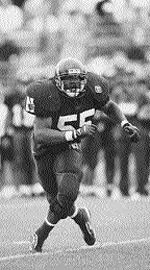
"He epitomizes the player I like to coach," Barnett said of Gardner, a linebacker who leads the nation in tackles (164) and the Big Ten in tackles per game (14.8).
"He's the spiritual leader of the team. He's also the vocal leader. He's a model as a player. He's an academic All-American. He loves practice and he plays hard every minute," Barnett said.
Gardner lettered twice as an offensive guard at Thornton High School in Harvey, Ill., never allowing a sack. But at just 6-foot-1 and 220 pounds, he knew no Division I school would recruit him.
The National Honor Society member had already applied to Northwestern because of its academics. When a former Wildcat told him he'd be a good fit for the program, Gardner asked Barnett if he try out.
Gardner switched to defense before training camp his freshman year, and the transition was a little rough. But what he lacked in technique he made up for in enthusiasm. He was always shouting and hollering, congratulating teammates on good plays and encouraging them when they made the mistakes.
He wasn't just working hard on the field. When practice was done, he headed for one of the dorms, where he worked as a security monitor. His parents were retired, and though they'd saved for his college education, the part-time job helped pay Northwestern's $20,000 costs.
"It actually was beneficial for me," he said. "I signed people in when they'd come into the dorms to visit, so I could get a lot of my homework done there. And I met a lot of people, too."
Just before training camp his second year, Barnett told Gardner he was going to lighten his load and put him on scholarship.
"We didn't necessarily see him as a great player. I put him on scholarship because the older players, at the end of the season, told me how impressed they were with his energy and enthusiasm in the locker room," Barnett said. "Whether he ever became a player or not, he was someone I wanted on my team."
As a redshirt sophomore, Gardner came into his own. Playing alongside All-American linebacker Pat Fitzgerald, he finished with 106 tackles and recovered four fumbles, second-best in team history.
Last year, he led the Big Ten in total tackles (174), solo tackles (112) and tackles per game (14.5). His two fumble recoveries gave him seven for his career, a new Northwestern record.
"He's a self-made guy and he loves to play the game," Barnett said. "Being a walk-on, he had to go make himself and earn that spot, so he has a different approach than most players."
Despite leading the Big Ten in tackles again this season, Gardner is often overlooked because of Northwestern's 2-9 record. When the 10 semifinalists for the Butkus Award were announced last month, he wasn't on it.
But Gardner shrugged it off. In five years at Northwestern, he's been to a Rose Bowl and a Citrus Bowl, and won two Big Ten championships. His 457 tackles are second only to Chuck Kern in Northwestern history.
Most importantly, Gardner, with a 3.35 GPA, is the first in his family to graduate from college.
"I think all players have that time in their life where they have to come to that realization: Is football what they want to do? Or is it not? Am I going to be a great player or am I just going to survive?" he said. "I decided from that moment that football was what I wanted to do for the rest of my life, if possible, and that I did want to become a great player. I just didn't want to be satisfied with being mediocre."