Northwestern University Athletics
The Skip Report: Kurt Anderson
4/2/2019 3:15:00 PM | Football
By Skip Myslenski
NUsports.com Special Contributor
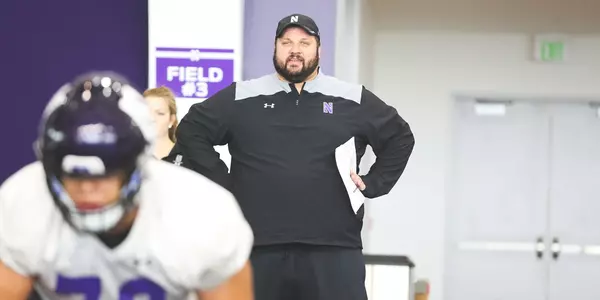
His name is Kurt Anderson and he is Northwestern's new offensive line coach. His Twitter handle is @olinepride.
"He wants us to take pride in ourselves and to take pride in being the leaders of this offense," Rashawn Slater, one of his linemen, will say when asked about that. "He wants us to be the tone setters for our offense. So everything we do, we're trying to create the identity that we're the leaders of this team and the team goes and we go."
"Me being the oldest guy in the room, it starts with me," adds another, the senior Jared Thomas. "So I'm going to take the responsibility each and every day, whether we're good or whether we're bad— there's no in-between. We talk about it all the time. To stay the same is to get worse. So we need to get better each and every day. So I've got to make sure we're trending in the right direction."
"It's two-fold," Anderson himself will say when asked about that handle. "One, it's what I'm trying to instill in my players. An identity is really what it is. It's an identity of who they are off the field, a standard we hold each other to. Being where we're supposed to be. Being on time. Never being the guys that are on a list for negative reasons. Guys who are counted on within the team, within the community, within the campus. Shouldn't have any issues with where their grades are at. That's what O line pride is off the field. On the field it's something very specific. Trying to be physical, nasty. We have a creed that right now we're in the process of earning. I can't give it to you. I can't tell you what it is. But it's one of those that's very motivating, something they can hold near to their hearts. Whenever things get rough or tough on the field, and adversity hits, they can always go back to that. We're in the process of earning that together."
Back in the second half of the 1980s, when he was coaching the Bear line that opened holes for Walter Payton and won a Super Bowl, Dick Stanfel described the quintessential offensive lineman as "A mean [expletive] on the field and a perfect gentleman off."
"That's a great quote. I'm going to steal that one," Kurt Anderson says when he hears that. "I equate it to Dr. Jekyll and Mr. Hyde. You've gotta be professional and go about your business in the right way and be a man of character off-the-field. On the field those things matter in terms of (staying) within the rules of what we're going to do.
"But you've got to be a ground-pounding monster and get after it."
That pride in self, that pride in position went this far with the Bears' Stanfel. He encouraged his players to view themselves as a tribe within a tribe and would bristle when anyone, even head coach Mike Ditka, had the presumption to criticize them. That was for him to do and he would do it privately, in closed-door meetings.
"There's a certain amount of pride in doing what we do," Thomas says when hearing that story. "There are guys— we call them guys who run around in short shorts on the perimeter who, like Coach Anderson says, can go play soccer. But we're in the unique position where we have to be athletes, but we also have to be strong enough to take on a bull rush, to move a 300-pound lineman from one spot to the next. From that standpoint we're unique, so in that sense it is true. We're a tribe within a tribe."
"We are not above criticism from our teammates, our coaches, our head coach. No way," Kurt Anderson will say. "But I'm a firm believer in as your line goes, your team goes. I'm sure there are other positions that feel the same way. But we want to be the guys who are consistently bringing the energy. We are the guys who can dictate the flow, the energy of a practice with our demeanor, with how we approach it. We can challenge our defensive line. We can make them better, they can make us better. I haven't been around too many teams that had an offensive line be energy vampires and saw a team that was successful.
"When you need to move the ball just that one yard, we should be able to put the team on our back and reestablish the line of scrimmage and get that yard. Obviously someone else has to carry the ball and all those things. But we want to be put in those situations, we want to thrive in those situations instead of being a unit that says I hope we score from distance so we don't have to do those. We want that. We want to to get to the mindset—we're not there—but at some point we want where we can tell a defense, 'This is where we're going to run the ball, this is what we're doing, and you can't stop us.' It's a mindset. It's a mentality. There's a lot of confidence that's involved in that and we're working (to get) there."
He is asked about those guys in short shorts who can go play soccer.
"If you look out there, right, receiver, there's guys from other sports who could probably go out there and athletically do some of the things they do. But you take guys from other sports worlds, who fits into what we do? Right? There isn't anyone. Power forwards in basketball? Mmmm. Centers in basketball? Nah. It just doesn't work out that way.
"I tell my O linemen all the time, 'Don't let anybody tell you you are not a great athlete. We are the most unique and special athletes in the world.' To do what we do, right, to move bodies, to move masses, and to be as synchronized as we are, it's about as athletic as one can get. I go, 'Nobody else on this field can come in there and do what we do. Take pride in that.' "
Anderson himself played center at Michigan, and has coached the O line in both the NFL (the Bills) and college (most recently at Arkansas).
"He's so technically sound. There's a technique for everything, and we're trying to learn and grasp that as fast as possible. That's why spring ball is so useful," Thomas says of him, and so his unit is still very much a work in progress. There is new terminology to master, and players are being cross-trained at various positions, and it will all not be shook out and settled until fall camp. But even now, halfway through spring ball, a tone and a standard have been set. "He talked to us the other day about mental toughness," says Thomas.
"He said, 'The hardest thing about being mentally tough is being present.' I think he does that every day. To be present you have to be engaged, and he's engaged when we're in meetings, when we're out here on the field. He encourages us in the meeting rooms and he encourages us out here on the field. It's infectious. We feed off of that."
"I was always taught that you either get better or you get worse," Kurt Anderson will say. "There is no such thing as staying the same because to stay the same is to get worse because you didn't get better. So we've got to outwork, out-hustle, outthink, out-communicate what we did the day before. I hold myself to that standard. I need to out-coach myself from the day before. They can't see any lessening in my tone, in my effort. That would be hypocritical. That's why, when I'm out there at practice, it takes two days for my voice to recover. It's a tone setting— I'm a firm believer that attitudes are infectious. So if there's an enthusiasm in the way you go about your business perfecting your craft, others see it and get infected by it.
"The negative can happen too. So if you're a guy who's always mopey, we call it the Fellowship of the Miserable. If you're part of the Fellowship of the Miserable, there's always open enrollment, and those guys, as soon as they see someone put his head down, those guys go and try and grab them and bring them to the dark side. It can go both ways. So if we're extra with it, if we're over-the-top with our enthusiasm showing our love of this game, that's going to permeate throughout the program. We're going to take it on us to set that tone on a daily basis, even in meeting rooms. So if I walk in the room and it's kind of dead and quiet, I walk right back out, I walk right back in, and usually they erupt and go crazy.
"It's like, 'OK. Let's get this thing going. We're here to learn. We're here to get better. This is an opportunity we can't let slip through our fingers.'"
He can get it going in different and distinctive ways. He might do impressions, or refer to movies, or simply ride the high fueled by the half-dozen cups of coffee he drinks each day.
"He's a little different. I never met anyone quite like Coach Anderson," Slater says of him. "He's like a ball of energy and it's infectious. Every day in the meeting room he's always saying something crazy, trying to get us jacked up."
"Honestly, he's done so many impressions I can't"—- Thomas says.
"He must have watched every single movie ever," Slater interrupts. "He can pull out any character."
"He'll say, 'Did you guys watch that movie?'" Thomas says. "And we're like, 'What are you talking about?'"
"Yep. Yep," Kurt Anderson will say when told of Slater's observation. "But it's all directed for a reason. There's method to the madness. I started out Saturday's practice, our meeting, with Rudyard Kipling's poem 'If.' I likened it to what a football player goes through. It could be throughout a day, it would be throughout a season, it could be throughout a career. If you look at that poem and what it's saying, there's a lot of things that just really hit home with them. I thought we had a great practice. . . .
"I think levity in itself is something that can be used. When you teach— I'm a firm believer that, scientifically speaking, people are either visual learners, audio learner or kinesthetic learners. So I try to figure out what each of my players are and I try to coach them individually. So for some of those audio learners, they can remember things if there's something humorous with it, something serious with it, whatever it may be. Sometimes it may be sing-songy, like 'Point your toe where you want to go.' Something like that resonates with a guy who's an audio learner.
"Changing inflection, making light of something, that's something that resonates. When you're correcting somebody and it's always stern, always stern, always stern, eventually you seem like a dictator. If you can make fun of it— most offensive linemen, just because of our nature, we're able to make fun of ourselves. So if you can make light of it. . .sometimes it helps them get over the hump."
And has he really seen every movie made?
He laughs. "I was tested at one point, an IQ thing, and I was near genius IQ," he then says. "I told my mom, I apologized to her. 'My mind is filled up with nothing but football and pop culture trivia, so I don't know if I took it to the full potential of what my mind could have done.' But those are what my head's filled with, and I'm going to use it to the best of my ability, and teach and coach it and share a little knowledge with them. I use some movie references sometimes. I think it's funny and I turn and look at them and they have no idea what I'm talking about.
"I'm like, 'Top Gun? You've never heard of Top Gun? You've got to watch it. It's a good movie.' He's (Pat Fitzgerald) a movie guy too. He uses quotes too. I laugh all the time. 'Our players have no idea what you're talking about. Only you and I know that reference.'"
There is another part of Kurt Anderson, who is married with five children, and that is his late sister Kaarin. He was just months old when she, at a little more than a year old, drowned in a swimming pool, and so he has no memories of her. But back in the mid-90s, when he played at Glenbrook South, he had her name written down the center of his helmet, and so here he is asked if she is yet an integral part of his life.
"My oldest sister played basketball in college," Kurt Anderson will finally say. "My oldest brother played college and NFL. My middle brother played college ball. I was able to play college and NFL. My dad played, my grandfather. So when she passed away when we were kids, she's been a huge motivating factor for me in terms of she never had an opportunity to hear a crowd yell her name or to have something written about her in the newspaper or anything like that obviously. Her life was shortened. God needed her in heaven. So she's always been a great inspiration to me.
"My brothers and sisters are nine, 10 and 11 years older than me. We were a year apart, so we would have some of those relationships I saw my siblings have. Not that I'm not close with them. I'm very close with them. But we would have had that relationship. It's also kind of fun, in terms of being a parent and having five kids, they're all two years apart, watching them grow together and seeing what they have— that's what I kinda missed out on in life.
"She's a huge motivating factor, an angel on my shoulder all the time helping me and guiding me. So when I have triumphs and pitfalls, I always thank her for looking over my shoulder and guiding me."
••••••
Be the first to know what's going on with the 'Cats -- Follow @NU_Sports on Twitter, become a fan of Northwestern Athletics on Facebook, check us out on Instagram, visit our Social Media page and download our mobile app from the Apple Store and Google Play! To get involved with the #B1GCats, become a season-ticket holder or join the Wildcat Fund!