Northwestern University Athletics
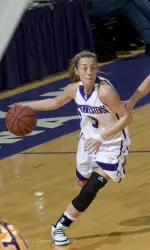
ON THE RECORD ... with Beth Marshall
2/5/2010 12:00:00 AM | Women's Basketball
Feb. 5, 2010
"There's something like a line of gold thread running through a man's words when he talks to his daughter, and gradually over the years it gets to be long enough for you to pick up in your hands and weave into a cloth that feels like love itself."
~John Gregory Brown, Decorations in a Ruined Cemetery, 1994
ON THE RECORD...with Beth Marshall
By Skip Myslenski
NUsports.com Special Correspondent
It is August of 2007 and the tsunami has not yet roared into her life. Soon, so soon, it will strike with a force both enervating and enduring. But here she is still unfettered and back home in Indiana and on her way to her old high school for an afternoon of torture. "I'm going with you to watch you do your workout. Make sure you're running hard," her dad suddenly informs her.
Together, then, they travel to the track, where she will prepare herself for the conditioning test she knows she will face when she returns to Evanston a mere few weeks later. This is a draining drill, dash 25 yards, slap the ground, dash the 25 back and then repeat, repeat until 300 yards are covered. "Everyone hates it," she says of this test. But here, under the summer sun, she pushes herself through it again and again, and each time she completes a run there is her dad with a comforting word.
"I love you, sis. You're doing great," he says.
"Every time I run the 300 now, I think about that," Beth Marshall will say. "As much as I want to stop and slow down, at those times when you just want to give up, I think of those things. They keep me going."
•••••••••••••••••••••••••••••••••••••••••••••••••••••••••••••••••••••••••••••••••••••••••••••••••••••
Less than three months later, on the day before she was to fly off to the first game of her sophomore season as the 'Cat point guard, the tsunami arrived with the force of an avenging angel. Now, for a good year, it would buffet her and batter her, bruise her and test her in ways that would have broken the many without her considerable reservoir of strength. She, not surprisingly, demurs when faced with that kind of description, saying with typical tenacity: "I don't want people feeling sorry for me."
But that is not the point, not the point at all. Look instead at Beth Marshall as a multi-faceted symbol, as a reminder that our athletes are not gods at all, but humans susceptible to the same horrors that visit each of our lives. Then consider how she responded and rebounded and now, no, there is no pity involved. There is, in its place, awe, admiration, appreciation for a resiliency and a spirit that just would not be extinguished no matter the forces it bumped up against. For Beth Marshall is back now and choreographing the 'Cats, back after a year when (in succession) she fractured her left femur, lost her dad to cancer and tore up the ACL in her left knee.
•••••••••••••••••••••••••••••••••••••••••••••••••••••••••••••••••••••••••••••••••••••••••••••••••••••
The father would be there for every game, arriving an hour early and settling into the same seat across from the 'Cat bench. "I actually had a hard time coming back this year because I didn't know if I could play without him," Beth Marshall will say. "Like, to this day, every time that we play, I look for him. I just picture him being there. Yeah. That was the hardest thing for me, trying to play knowing he wasn't going to be there. My mom and Brad (Phillips, the former 'Cat safety and her boyfriend) make it so one of them is at every game now. They know how hard that is for me."•••••••••••••••••••••••••••••••••••••••••••••••••••••••••••••••••••••••••••••••••••••••••••••••••••••
She picked up basketball when she was 12, after a shoulder injury derailed her gymnastics career, and from the start she was a terror, even when faced off against her older (by 13 months) brother Todd and his friends. "I was literally like one of the boys. They were so rough on me. They didn't care if I was a girl at all. Maybe that's what made me tough to begin with," she remembers.The family was in Kentucky now, where playing up is permissible, and as a mere sixth grader, she was a starter for Russell High School's varsity team. Two more years of starting followed and then, after a move to the Indiana town of Fishers, there were four more with the varsity of Hamilton Southeastern. She was starting too by the end of her freshman season with the 'Cats and so, as she prepared for her sophomore year, she carried a resume that was star-kissed and filled with success.
But now, too, she was in pain and so went for an MRI the day before they would leave for their season-opening tourney in New Mexico. "You're not going to be playing," the doctor told her here.
"He said," she recalls, "'If you continue to play on it, we're going to have to stick a rod down your femur. Then you'll have to learn how to walk again. And there's a chance you won't be able to play. And at some point we'll have to go back in and take it out.' It's not something you can live with. It was like an eight-inch rod. So I definitely wasn't going to take any chances with that. I was just out. I was crushed."
So you were inactive for the first time in your life?
"I was. My mom, I can distinctly remember her saying, 'I've never seen you sit out.' I wasn't allowed to do anything. I wasn't allowed to bike. I wasn't allowed to walk. Nothing. She could see I was going crazy."
•••••••••••••••••••••••••••••••••••••••••••••••••••••••••••••••••••••••••••••••••••••••••••••••••••••
The father was known by all the 'Cats. "He was," Beth Marshall will say, "famous on our team for cheekers. He always gave every girl after the game a kiss on the cheek. Last year, after he wasn't there, they were like, 'We miss our cheekers.' All the girls loved him."•••••••••••••••••••••••••••••••••••••••••••••••••••••••••••••••••••••••••••••••••••••••••••••••••••••
She was, despite her injury, with the team in Michigan on that January night the call came and getting ready to leave for its shoot-around at Crisler Arena. "We're going to Barnes-Jewish Hospital in St. Louis. I'm going to get this tumor removed in my brain," she heard her father say.
"I'm thinking, 'What the heck? Why is he so light-hearted about this?'" she remembers. "I'm like, 'OK. Whatever. I'll call you back afterward.' But I had this gut feeling it wasn't as simple as he's making it seem."
She was right, as her mother made clear in the call she soon made, and an hour later Beth Marshall was on a flight out of Detroit and on her way home. Her father had glioblastoma, the same brain tumor that would kill Senator Ted Kennedy.
•••••••••••••••••••••••••••••••••••••••••••••••••••••••••••••••••••••••••••••••••••••••••••••••••••••
"Before he physically started deteriorating in the summer, I was shooting one day, I think it was June, he came out and he was trying to rebound for me," Beth Marshall will say. "I remember that a lot. Just that day. That was the last time I had that basketball connection with him. Other than coaches, he's the one who taught me everything. Shooting. Being a humble player. Not being cocky. Good sportsmanship and those things. He taught me all of that, the things that really matter when you step on the court. That's the last basketball memory I have of him. I carry it with me all the time."
•••••••••••••••••••••••••••••••••••••••••••••••••••••••••••••••••••••••••••••••••••••••••••••••••••••
She spent the winter and spring quarters of 2008 shuttling between Evanston and her family home in Fishers, but with the help of academic advisors, still remained fully enrolled. ("They're saints. They made it possible for me to do what I did.") She was also beginning some light rehab and so, for her 20th birthday in May, her parents came up to Evanston and they had a family cookout outside her apartment.
But, back in February, her dad had been operated on at the Duke University Medical Center by Dr. Allan Friedman, the same surgeon who would later treat Kennedy, and there learned that his cancer was stage four. "The worst," remembers Marshall. "He basically had the left side of his brain removed to try and get the cancer out, but there's no cure for GBM. So it's just a matter of time when it comes back. After surgery, the average prognosis is six to 18 months. My dad was in the eight month range."
He would die on August 28, eight months and 23 days after he was first diagnosed.
•••••••••••••••••••••••••••••••••••••••••••••••••••••••••••••••••••••••••••••••••••••••••••••••••••••
"He just loved to watch me play. He never missed a game," Beth Marshall will say. "He even went to the Bahamas (for a tourney the 'Cats played in during her freshman year). He drove to Nebraska. He never missed a game. Even when I wasn't playing, he never missed a game until he got sick. In his last coherent days, we'd talk about games. But there were times when he couldn't remember I played basketball. That's what happens. It was really hard on me that way."
•••••••••••••••••••••••••••••••••••••••••••••••••••••••••••••••••••••••••••••••••••••••••••••••••••••
There was a service in Fishers and then another in Kentucky and a third one in Portsmouth, Ohio, where she had been born and her father was buried alongside his parents. Now she took a week to recuperate and then she was back in Evanston, where on a Tuesday in September her doctors told her, "You're fine to go.""I was so excited to be back," she recalls, but five days later, in just her second pickup game since her return, she went up for a fast break layup, landed and felt pain in her knee. "I didn't even know I was hurt, to be honest," she now goes on. "I was like, 'Wow, that really hurt my knee.' But I got up. I could walk to the training room."
"I think you need to call Brad and have him come up here," the athletic trainer told her after examining the knee.
"I'm like, 'OK. But I can walk. I'm fine,'" Marshall remembers.
"I think you tore your ACL," the athletic trainer would say after Phillips' arrival. "We need to send you to get an MRI. But all of our tests, that's what it's leading toward."
"I started crying," says Marshall. "I'm like, 'Are you serious?' I was speechless, seriously. But sure enough. I got my MRI and it was torn."
•••••••••••••••••••••••••••••••••••••••••••••••••••••••••••••••••••••••••••••••••••••••••••••••••••••
There have been tears and wistful gazes, pauses and struggles to continue. But, through all of her recounting of her time in the tsunami, Beth Marshall has persevered and that is in character. So, too, is her answer when now she is asked if ever, ever during her time in the storm, she thought to herself, "Why me, God?"
"I almost see that question as kind of pointless, to be honest. Because it is me," she says. "My mom and I developed, it is what it is. You just deal with it. You pull yourself up by the bootstraps and move on everyday. So I don't think I ever. Maybe I did. I can't really remember. I never, ever wanted anyone to feel sorry for me or any of that. I know people have it so much harder than I do. Yeah. It definitely was not fun breaking my leg and tearing my ACL and losing my dad. But I know that there are people that go through much worse on a daily basis. I have so much to be thankful for. My coaches. My teammates. The family that I do have. Being at this wonderful school and the people that take care of you. I guess I just try to focus on that part of it more than the negative."
Did she ever get depressed?
"There were days when I kind of felt bad for myself. But, I don't know. I tried to focus on, I knew where I wanted to be. I knew I wanted to get back and play, to be a contributing member of my team. Family wise, we're still not over, you're never going to be over something like that. People always say it gets easier. I strongly believe, no. It doesn't get easier. You just learn how to handle it. There are still times I pick up the phone and punch up my dad on speed dial. That's instinct for me. I don't know. There are still days when my knee swells up and hurts. And I'm still trying to develop my quad muscle. But I don't think I gave myself time to be depressed because I didn't want to be in that state. I wanted to be happy. I wanted to appreciate being healthy again and the family that I do have."
Where's that strength come from?
"God, for sure. My dad was very. That's actually what we talked about the entire time at his funeral, kind of, was how he was faith. So definitely my faith. Then my family and I include Brad in my family for sure. Then my teammates. Inside, I don't ever want the things that have happened to me in the past to define me. I don't ever want to be that story. 'Oh, she tore her ACL. That's why she didn't play anymore.' Or, 'She lost her dad. That's why she is the way (she is).' I didn't want those things to define me.'
You want to make the choice?
You want to determine your future?
"Yeah. Yeah."
•••••••••••••••••••••••••••••••••••••••••••••••••••••••••••••••••••••••••••••••••••••••••••••••••••••
She pushed herself to return from the torn ACL and reclaimed her starting spot as the 'Cat point and then, in mid-December, was once again a terror, raining in eight threes and scoring a career-high 24 in her team's win over Arkansas. This was a signature moment, her coming (back) out party, the reappearance of the phoenix, which is described by one feng shui master as "a mythical bird that never dies. . .(that) with its great beauty creates intense excitement and deathless inspiration."That, too, certainly describes Beth Marshall and here, when asked about that afternoon against the Razorbacks, she smiles broadly. Then, still aglow, she finally says, "I can't even tell you where any of my eight three pointers were from. I can't tell you what move I made or what plays we were running. I didn't even know it was that big of a deal until Julie Dunn (of the 'Cats athletic communications department) told me, 'Look at what you just did.' I was, 'Oh my goodness. I'm back. I'm playing and I'm having fun.'
"I was in the zone. I knew and after that game, I actually (said to myself), 'Your dad would have been so proud.' And he would have. That means more to me than breaking any records or anything like that. I gained respect back for me as a player too because there are people out there, 'Oh, she can't do it.' Well, I did.
"Yeah. I'm back. I'm not staying down. Never have. Never will. I feel better than I was in the past. I made a new normal for myself. It feels great."