Northwestern University Athletics
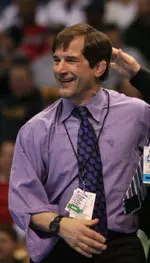
ON THE RECORD ... with Tim Cysewski
2/18/2010 12:00:00 AM | Wrestling
Feb. 18, 2010
Match Notes vs. Wisconsin, Michigan 
EVANSTON, Ill. -- Northwestern goes in search of a win in its regular season finale when it hosts Michigan Sunday in a 6 p.m. match televised live by Big Ten Network. In honor of the match being Tim Cysewski's final dual contest before sliding into the assistant's chair, NUsports.com's Skip Myslenski went ON THE RECORD with Cysewski to discuss his lifelong journey in wrestling.
Cysewski's head coaching career will be honored in a ceremony during intermission of the 'Cats' match against the Wolverines. For live scoring of that match, click here; for complete information on both of Northwestern's season-ending dual matches, download the weekly release linked at the top of this page.
ON THE RECORD
On Sunday, against Michigan at Welsh-Ryan Arena, Tim Cysewski will coach his last home match as the head of the 'Cat wrestling team, which next year will be guided by current associate head coach Drew Pariano. It is not that Cysewski is fading off into retirement. He will be back to himself serve as an assistant to Pariano. But the occasion not only marks the end of his 20-year run, which he finishes as the winningest wrestling coach in school history. It also provides some time to look back on the long journey in wrestling he began many incarnations ago.
I started in the eighth grade. It was at the park district. A friend of mine, his brother wrestled. He said, 'Hey, why don't we go to the park district and do this wrestling stuff every Saturday?' I said, 'OK. Why not?'
It was something different. We didn't do anything during the winter anyway, you know. So we did it and I liked it. I liked it right away. It was physical. It was combative and I felt pretty at home with it. So I kept doing it.
It was something I enjoyed right away. It was instant. I just knew I wanted to do this. It was a good feeling. It was a good workout, something physical and there was definitely a skill level there that you had to have.
They had state tournaments in junior high and I said, 'OK, let's do that.' I ended up fourth in the state that year, my first time wrestling. I said, 'Heck. I like it. I did pretty good at it. This is something I want to do.'
I kept telling myself, 'What's next? What's next? What else can I do?'
We had a place down there (in the basement of his family's home). He (his dad) had some kind of rubberized surface, we put the carpet over that. We used to go down there and wrestle on a regular basis. We had a sauna down there, some other stuff down there. It gave us the opportunity, if we wanted to get another workout in, we had access to it.
In high school, when I was really focused on doing it, I realized I wanted to do it all the way. It was just easier. 'Ok, we want to get a workout in. Let's go downstairs.'
We usually did have fights. I have a twin brother that was a gymnast. Then I have a brother who's a year younger than me, Danny. Then the baby of the family, Paul. We all wrestled. Even Kenny the gymnast wrestled.
They would definitely spill upstairs and stuff. Mom, a typical Italian mom. She could understand it, but at the same time, 'Hey, stop it.' Sometimes she would chase us around with her broom a little bit, trying to keep it under control. That was kind of fun, those days.
I wrestled in the summer trying to get caught up because I was so far behind. Not so far behind. But a lot of people had two or three more years of experience than I did. So I figured, 'If I'm going to do this, I better learn more, get involved more.'
It was always, 'OK. What's the next stage, the next level?' In eighth grade, it was still new, 'What do I do?' 'State.' 'OK. Let's do state.' You had to qualify and all that kind of stuff. That was all very new to me. I liked that. It was something new and exciting. Then I said, 'OK, what's after this?' 'High school.' 'Well, high school, do they have state tournaments?' 'Yeah, yeah.' 'A state champion?' 'Yeah.' 'Well that's what I want to be.'
In my mind, I wanted to be a state champ.
Fortunately enough, I had a great coach at Glenbrook South. His name was Bill Fuller. He was an Iowa guy, an All American at Iowa. I didn't know Bill at all at that time. But I started showing up at the high school in eighth grade. I started working out with the guys who were in the room and kept picking things up, started wrestling more in the summer.
At that time, that was kind of new, wrestling in the summer. Now everybody does it. Now it's almost like you specialize in the fifth grade in what you're going to be doing the rest of your career. But that was still very new at that point.
I don't know that I gave anything up. I didn't see it that way. I was very involved in the homecoming parades. I liked to help with the floats and all that kind of stuff. Did I date a lot? Probably not. I was pretty focused on trying to do as well as I could in school and wrestling.
Yeah. I went to senior prom, but it wasn't something I had to do. It wasn't on my, 'Oh, I've got to do that (list).' I did it. But if I didn't do it, I wouldn't have regretted it. I just did it. OK. Fine.
In 1972, while wrestling in the 119-pound weight class for Glenbrook South, Cysewski did win the state championship and then he moved onto Iowa. He there ran up a career record of 99-23-4 and, as a senior, finished third nationally, earned All American honors and co-captained the national champion Hawkeyes. It was during this time too that he met and then befriended Dan Gable, the most legendary name in U.S. wrestling.
I got a note in July. 'Here's your next assistant coach.' It was Dan Gable. Everyone knew who he was at the time. He was at the Olympics (in Munich, where he won a gold medal). We were excited about being around the guy.
The first week back, he went from the Olympics to coaching. Wow. That was great.
He used to work out with us all the time. It was one of those dreaded, you loved doing it, but at the same time you hated going through the workouts. Especially if he tapped you on the shoulder and said, 'C'mon, let's go workout.' 'Oh, great.'
You knew you were going to have your hands full, that it was going to be an even harder day than you first thought.

Tim Cysewski won five consecutive Midlands championships as a competitor.  |
|
Looking at Dan, a couple things (stand out). A lot of confidence in your preparation. Knowing that you've done everything you can to prepare yourself to win. And just being positive. Dan was always a positive guy. Always. Even in the worst situations, he was always positive. That was something I learned a lot.
I also saw that in all the other coaches I had. They were all positive people. You had a bad day? OK. Fine. We'll work on it, change you, make it better. There was always a positive outlook.
Dan was just a hard working guy. Every time I saw him, he challenged himself a lot. I would watch him work out with guys two weight classes bigger than him and beat the heck out of them. Then I'd wrestle him maybe a week or two later and I'm like, 'Is he sand bagging on me? Is he letting me do certain things?' Didn't matter. He still beat me up pretty good, got me tired.
I graduated in '76, but I stayed there and wrestled for the (Hawkeye Wrestling) Club, and helped run the club, until 1980. I wanted to make the Olympic team. Then we had the boycott (of the Moscow Games).
It was one of those tough experiences. It's one of those things in your memory that you'll never forget. You know exactly where you were. You know exactly the situation.
When (former President Jimmy) Carter made the announcement, we were in the final trials. We were literally in the final trials. We were literally going through our best-of-three matches. We learned going into those matches that, right now, there was a boycott on, that we weren't going to send our U.S. guys.
We all kind of looked at each other and said, 'Do we go through with this?' Of course you go through with it. We did. But it definitely tainted it. You're like, 'Gosh, here I spent four years training.'
Quite frankly, that's one reason I'm not a Democrat. I say that jokingly. But, yeah, that told me, I said, 'Politics doesn't have anything to do with it.' And when they pulled that card, I told myself, 'No way. It should never have happened that way.' It never should have happened in my mind. No. No. It's kind of funny. But that is one reason I'm more of a Republican than a Democrat.
I made world teams and Pan Am teams and traveled all over the world in those four years. So from my standpoint, it was worth it. But, ultimately, with me, I always was, 'OK, what's the ultimate in this sport?' If you're going to be involved in a sport, what's the ultimate? Well, you want to be on the Olympic team, a gold medal winner. That was one piece of the puzzle I didn't get. Or even have the opportunity, I should say, to get.
I basically said, 'Eighty is over with. I've got to grow up now and wrestling is over with.'
Gable did come to me after that and say, 'Hey, do you want to run the club for a year?'
I had a job lined up. There was a hardware store guy that wanted to hire me up in Cedar Rapids. My wife at the time was working for Link-Belt up in Cedar Rapids. . .(and) I had an agreement I would go work for this place in February.
I was basically going to manage a hardware store.
I ran the club for a while. I wasn't going to start this job 'til later. Then I get a call from USA Wrestling and they say, 'Since you guys didn't go to the Olympics, we want to take you to New Zealand for two weeks to compete.' I'm going, 'That would be kind of cool.' It would have been like a last hurrah. But I always had in the back of my mind that I had this job sitting over here. Come February, I have to go.
I asked USA Wrestling, 'When's the trip?' It's February whatever, the fifteenth. I told them, 'Well, I have a commitment I have to uphold. But if I can get them to delay it, I definitely want to go.'
I called my potential new boss. He said, 'Nope. You either show up or that's it.'
I asked my wife, 'What do you think I should do?' She told me, 'Do what you want to do.' I thought about it and for some reason I just said I wasn't ready. I wasn't ready. I wanted to get one more trip in. I still felt good about what I was doing.
I called the guy up and said, 'Hey, I'm going to take that trip to New Zealand, so count me out.' I felt bad. He didn't have to give me the job, but he did. Then I turned it down and I'm going, 'I hope I did the right thing?'
I guess looking back on it, I did.
I competed that last time, ran the club for Gable and then, as that's going on, (then 'Cat wrestling coach) Tom Jarman talked to me right during the Midlands and asked if I'd consider coming home to Chicago and coaching with him.
I told him I was helping Gable run the club, that I had other things lined up. But maybe a year from now, if it was still available, I'd definitely be interested in it.
This was all happening at one time. I had that job offer in Cedar Rapids. I have the New Zealand thing. Then all of a sudden I had this thing offered to me at Northwestern. I said, 'Gosh.'
I told myself, 'Well, I want to do the New Zealand thing, compete one more time. The job in Cedar Rapids, I already said no to that.' The situation at Northwestern, I told myself, 'Tom's going to want a guy who can get in there quick.' He's not going to wait a year for me to finish up with Gable at the club. So I figured in the back of my mind that that opportunity wasn't there either. So I just went ahead, wrestled and ran the club.
Probably three months later, Tom called me again and said, 'Hey, that offer's still on the table.' I listened to him and said, 'Let's sit down and talk some more details.'
I talked to him, talked to my wife a little bit, then I told my wife, 'Let's do that.'
She was going to try to get transferred from Cedar Rapids to the headquarters here in Chicago of Link-Belt, which she did. So I told Tom I'd take the job.
Then I had to tell Gable. Nobody left Iowa.
They made it pretty comfortable there. You had fun with it. The program was growing, getting better. We were national champs. So things were going.
In the back of my mind I thought if I talk to Gable about it beforehand, I was concerned I'd get talked out of it. So I didn't do that. I really wanted to blaze my own trail. So I made the decision up front.
Then I had to tell Dan at the end of the year. 'I'm leaving. Thanks for all the opportunities. But I'm leaving for Northwestern.' He looked at me and said, 'I wish you would have told me earlier.' I said, 'Yeah, Dan. I know exactly what would have happened. That's exactly why I didn't.' He said, 'Hey, good luck.' Everything went fine.
I talk to him all the time. We keep in contact as much as we can.
Cysewski spent eight years as Jarman's assistant and then, when he left to take over as athletic director of Manchester College in 1990, succeeded him as the head coach. In his inaugural season he guided Jack Griffin to a national title, the team's first since 1973, and the 'Cats to a school-record fourth-place finish in the country. His teams did struggle as an old century ended and a new one dawned, but eventually he resurrected it and not only drove it to another fourth place finish nationally in '07. He also produced an individual national champion in each of the last three years, a feat unmatched by any of the country's other coaches.
I knew I wanted to give this a try. I knew I wanted to coach at this level. It goes back to what I always told myself. 'Ok. What's the ultimate?' To me, coaching in the Big Ten was like the pros. You can't find a better conference to coach in.
Why Northwestern? I guess they picked me. Tom picked me. I'm a local kid, I kind of fit, I knew Northwestern from growing up around here. I just felt comfortable here from the get go.

Cysewski came to NU as an assistant under Tom Jarman and led the 'Cats to a fourth-place NCAA finish in his first year as head coach. |
|
There was a lot to learn, especially at Northwestern. It's a different kind of clientele you recruit here versus Iowa or any other state school.
There are a lot of challenges coaching at this school versus other schools. But I like those challenges. It means more when things do go the right way, when you put a plan together and it goes the right way. Then you're like, 'Good. We did it the right way.'
Yeah, we had about four or five years there that were pretty bad. Now we're back. I've always looked back at that and (asked myself) what did I do differently? Did I recruit different kids?
I think it was a combination of a lot of key injuries, it was kind of flukey. We'd have guys hurt and they couldn't make it back because of injuries. Or they'd get hurt and then say, 'Nah, I'm not doing this anymore.' That happens here, if you have some critical guys do it, you can't recover as quick as you'd like to. Other schools, they have the depth where they can recover. That was the biggest problem.
It took some time to get back on track. I knew we could get back on track and we did. It just wasn't as fast as I'd like it.
We were still recruiting state champs. Quality is quality. You can't beat that. Then also you try to get some diamonds-in-the-rough too. Maybe back then I was looking for more diamonds-in-the-rough than I probably should have. That could be.
My philosophy is probably a little different from a lot of coaches. I'm not all about my won-and-lost record. It's not about, 'Well, I have 200 wins and five losses.' If that happened, great. But my attitude is I'm here to bring student-athletes to Northwestern, to give them a chance to graduate and to give them an opportunity to be a Big Ten champ, a national champ. It's all about the kids.
If we win dual meets, if we win tournaments as a team, great, fantastic. That's icing on the cake. But I always look at myself and think, 'How can I help this guy meet his goals both in the classroom and also in wrestling.'
Ultimately, when they're done, people are going to say, 'Well, what did you do at Northwestern?' 'Well, I won the national championship.' 'Really.' 'I was two-time Big Ten champ.' 'Really.' Very rarely will they ask, 'Well, how did the team do?'
It's the opposite of football or basketball where the team concept is so important. It's important in wrestling, but not as much.
Winning national championships. Jake (Herbert) a two-time national champ, the Hodge Trophy winner (emblematic of the country's top collegiate wrestler). Not too many coaches can say they were involved in that. He did all the work. But I think we helped him meet his goals. Dustin Fox being heavyweight champ. Those are all great memories.
Then again, there's guys out there who didn't attain those goals. They had goals like that coming in, but for some reason they didn't make that. But they're lawyers now, doctors, being very influential in their communities, and they're still involved in wrestling, giving back to the sport.
Overall, for me, wrestling has been camaraderie, knowing there's always those tough times, but if you work through it, stay positive, good things will happen.
I still think there's good things to come. I'm not done here. Just because I'm changing chairs doesn't mean I'm not going to be part of it.
I'm not using the word retiring. I'm still coaching. I'm still going to be here. I'm still going to recruit, all that stuff.
If I was walking away from it, that's retirement. I'm still going to be very active in coaching and recruiting. It's just that I won't be head coach anymore in title.
Drew's going to be the new head coach. It's one of those things, when you see the talent coming up, you say, 'That guy's got to be the head coach here.' He's going to be a great head coach. He's got it all. I recruited him. He went to school here. He knows the ways of this place inside and out. It's just one of those feelings I have. I can't put a handle on it. But I know he'll be fine.
I just feel the team will be better if he's the head coach right now.
I'll be his associate head coach. We're just switching titles and chairs, I guess.
One thing I've learned, I always ask for opinions and gut feelings. There's a lot of talk about what we want to do personnel-wise, recruiting-wise. It's an ongoing conversation, all the time.
We have a wrestling team. We also have a coaching team. When the decision is made, yeah, the head coach has to make it. But there's a lot of deliberation among us. It's not just one guy making that decision and that's going to continue.
Gable and I were talking at the Midlands this year. He said, 'You're going to do the assistant coaching thing again?' I said, 'Yeah, Dan. You were the same way.' When Tom Brands took over (for Gable at Iowa), Dan was the assistant for a few years.
I'm going to try it. I like coaching. I like being involved with the guys.
There's always that (fear) part. I've always done it. Can I do something else? Sure. Sure. What that might be, I don't know. But if there's a time when I make my mind up it's time to walk away from it, I'll know that.
Right now, I feel good about where we are as a program and I feel even better that Drew will be the head coach starting next year and that I'll be part of it.
It just seems like yesterday that I got here. When you're having a good time, time goes pretty fast.