Northwestern University Athletics
"The Play" - An Oral History
7/2/2017 9:36:00 PM | Men's Basketball
Northwestern's dramatic buzzer-beating basket against Michigan March 1 at Welsh-Ryan Arena is in contention for an ESPY award for "Best Play." The play is one of eight remaining contenders with voting running through July 4. To vote for the Wildcats, please visit: http://bit.ly/BestPlay2
By Jasper Scherer
Northwestern Athletic Communications
The play that every Northwestern basketball fan will remember years later — the one that transformed a 78-year-old tarnish on the Wildcat basketball program into a bad memory — lasted only four seconds. It sent shocks of relief and ecstasy through the Northwestern faithful, setting off a cascade of purple from the Welsh-Ryan Arena bleachers down toward a dogpile of basketball players in the middle of the court.
Nathan Taphorn's 88-foot pass to Dererk Pardon, and the 6-foot-8 center's subsequent finish off the glass, overshadowed the other 39 minutes and 58.3 seconds of what proved to be one of Northwestern's wildest games ever. The 67-65 win over Michigan was NU's 21st of the season, a school record.
The two teams arrived at Welsh-Ryan riding opposite trajectories, but with identical motives. Northwestern had lost five of its last seven games, capped by a devastating last-second road loss to Indiana. Michigan, winners of five out of six, was coming off a blowout win against 14th-ranked Purdue. Both teams were 9-7 in the Big Ten.
A win, according to every bracketologist on the planet, would seal Northwestern's first trip to the NCAA tournament. This is the story of the game, and the play, that sent the Wildcats dancing.
———————
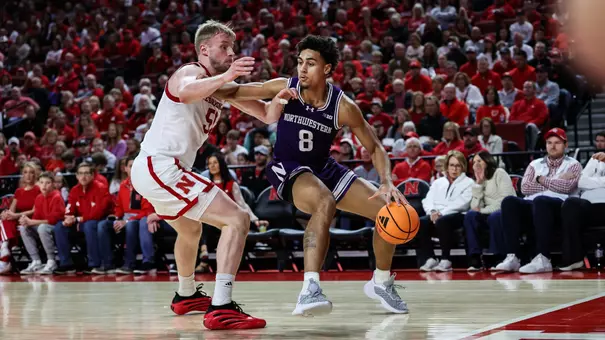
Welsh-Ryan Arena's size belied its character that night. Packed to a breaking point, fans rallied around their struggling team. The overflowing student section carried an attitude of nervous excitement mixed with slight desperation: A win for Northwestern would be momentous, maybe the biggest in program history. A loss would be devastating on a similar scale. The decibel level inside Welsh-Ryan matched the game's significance.
Dave Eanet, Northwestern play-by-play broadcaster on WGN radio: Sporadically over the years there have been games where the place has been amped up. But I just felt walking in, knowing what was at stake, that there was sort of an extra excitement in the place.
Gary Ross, public address announcer: I've been coming to games here for a very long time ... The atmosphere, just the sound level of this arena, we always knew it had that potential. But to have that happen this year, it's just been so much fun.
Brian James, assistant coach: Every coach and every player would be lying if they didn't tell you that that's what they dreamed of, to play in an environment like that.
Bryant McIntosh, guard: It's awesome, just because you're not always the one that has to create the emotion in the gym. You can rely on the student section to bring some noise and energy. And that allows you to play with a little bit more energy, it gives you a little bit more juice. It's a big key.
Chris Collins' instincts told him not to duck the issue any longer. For weeks, he told his team not to think about the one thing on everyone's mind: ending NU's 78-year NCAA tournament drought. Northwestern embraced the "one game at a time" adage and kept winning games — until the losses started piling up, and the possibility of a collapse became real and imminent. One regular season game remained after Michigan: a home game against Purdue. So Collins delivered a message to his team before practice on Monday, two days before the Michigan game.
Chris Collins, head coach: I've talked all year about how we've tried to stay focused on what's in front of us and come up with other motivations. ... I decided to go completely away from that. After Indiana, I came in and I challenged them. And I told them there was pressure.
James: Chris knows the psyche of our team better than anybody, and the nuances of coaching and staying positive or being real.
McIntosh: He did make a great point. It was time to stop dancing around it, and avoiding it, and not saying much about it.
Collins: It was the first time I said, 'Guys, there is pressure. And anything good in life involves handling pressure and succeeding under pressure. So we're not gonna avoid it anymore.'
James: We're all human, so we all read the stories. We're on social media, we hear ESPN, and they say we need to win one more. And we know we have Purdue coming in on Sunday. So it made the Michigan game all that more important.
Eanet: The general consensus — whether or not you believed the bracketologists — there was general anxiety that if they didn't win one of these games they would get left out. That kind of ratcheted things up a little more. And when you add the fact that Michigan was playing really well, and they knocked Northwestern out of the Big Ten Tournament [last year], it was kind of a perfect storm.
McIntosh: Everybody was talking about a collapse, and it was time for us to own it — own the moment, own the pressure. And we'll either fold or do something great.
Vic Law, forward: We knew coming in that if we wanted to be different, then this was the game that we need to take. This was the game we needed to stop the bleeding on.
Dererk Pardon, center: We just knew as a team that we had to win. We told ourselves we were going to die before we lose this game.
Finally, at 6 p.m., the game tipped off. Law set the tone for Northwestern, scoring two early buckets while leading the way to a 26-16 early edge. He would finish 7-of-10 from the field.
Baldwin: [Vic]'s very important to our team. A lot of teams are throwing the kitchen sink at BMac, and Scottie Lindsey gets a lot of attention now that he's back. We need Vic's production in order for us to be successful.
McIntosh: It started at the beginning of the game. I came up to him, and I told him, 'I just believe in you, and you're going to have a big game.' I just had a gut feeling that he was going to play well. He had worked hard the past couple days, he was really locked in.
Baldwin: We talked with him about taking advantage of his size and getting into the paint or the elbow area.
Collins: He got a short pull-up the first play and then a layup. I thought he had a lot of energy.
Law: It was really important for me to go to the basket early. I think in other games I had been taking tougher, pull-up jump shots, which I can make, but most of them were off-balance. It's hard to get in a rhythm when you start a game and you go 0-for-3 starting it off.
Pardon: We just told him to stay confident. Once we said that, he knew what he had to do and he just executed.
Northwestern's early lead dissolved by halftime. The Wolverines pulled within two, 30-28, then leveled the score with 11:37 to go in the second half. Neither side could gain a clear advantage. After Michigan forward Moritz Wagner's layup with 9:25 narrowed the Wildcat lead to 56-54, neither team led by more than two points for the remainder of the game.
Baldwin: Both teams were playing desperate. I know that they were playing desperate because they were trying to fight for the same thing that we were.
Eanet: I had the feeling that it was going to be one of those games that came down to the wire. It was not a game that seemed to be in anyone's control.
Northwestern tried to stymie Michigan's screen-heavy offense by repeatedly switching on defense. Offensively, NU found success distributing the ball with 20 assists on 27 baskets.
Baldwin: The one thing they tried to take advantage of is, we were switching smalls onto bigs, so that was creating some mismatches.
James: Everybody's gameplan is to take the ball out of Bryant's hand. Sanjay [Lumpkin] and Gavin [Skelly], instead of staying hidden on the baseline, they had to punch up to the free throw line area. And they made some really great reads, passing out of that and scoring themselves.
McIntosh: Their defense was doing a good job trying to take us away from some of the things we like to do. They're a really good team and they were playing some of the best basketball in the entire league.
Pardon: When we're pretty good, we have a lot of assists. We knew that we had to get back to playing that game, and a big part of that was getting the ball to the open man. I think once we did more of those dribble handoffs, more guys were open.
Collins: I just love the things that guys were saying in the huddle. Every time Michigan made a little run, we'd come to the huddle and our guys were saying, 'We're not losing. We are winning this game.' They kept reiterating it to each other.
Eanet: Both teams played so hard. Every time I looked up, [Michigan point guard] Derrick Walton [Jr.] made a big play, and we're answering at the other end. It was just one of those kinds of games. You just felt like something out of the ordinary was going to happen.
The game started to get weird around the six-minute mark, when Walton Jr. stepped to the line to shoot a one-and-one with the game tied at 58.
The referees had signaled for two shots, despite calling a foul on the floor. So when Walton missed his first attempt, Lumpkin nonchalantly grabbed the ball and handed it to official Terry Wymer. After a discussion, the refs ruled a dead ball. Michigan had the possession arrow, so they received the ball, then scored a go-ahead layup.
Eanet: I don't remember saying it was one-and-one. So when the free throw was missed, I didn't think much of it. Then I realized, didn't the ref indicate that? We're trying to figure it out. The only thing I knew was they ruled nobody had possession.
Baldwin: With the one-and-one, you hope that your referees understand that both teams are fighting for their lives here and we can't have that type of mistake, similar to what we would say to our guys in certain situations.
Eanet: It was a huge call, and potentially could have cost Northwestern the game.
Shortly after, with the game tied 63-63 just before the two-minute mark, Lumpkin fouled Wagner while battling for an offensive rebound. As the 73-percent free throw shooter stepped to the line (the Wolverines were in the bonus), Michigan head coach John Beilein gathered his team near the sideline. Then, just before Wagner shot, Walton Jr. stepped over the 3-point line and was called for a lane violation, negating the free throws.
James: I think the coaching staff for Michigan got mixed up and thought it was a two-shot foul where he wanted to talk to his team on the first free throw. And then when they crossed the three-point line, [official] Gene Steratore, he was on it. He made the correct call, and there was no argument from their bench.
Beilein: I was trying to huddle our guys up, and somebody says it's a one-and-one. And Derrick, for some reason, he ran in like he'd be at the line. I have no idea why he did that.
Baldwin: They're probably thinking now, if we didn't have the lane violation, maybe Wagner hits two free throws. Who knows?
Beilein: I was trying to tell them what they were going to run at the other end, and just use that time. … So that was a tough break.
Eanet: I didn't see the violation occur. I just saw [the refs] signal lane violation. I think I said something like, over the course of a game or a season, you're going to have your share and you're going to have your share go against you. The one-and-one could have gone against them. They get a break and we get a break.
James: One went in Michigan's favor, one went in our favor, so they kind of balanced each other out.
On the ensuing possession, Pardon set a screen for McIntosh at the top of the key, pulling Wagner out of the paint. Lumpkin was left alone with Zak Irvin near the basket, McIntosh's pass found him, and the redshirt senior finished the contested layup. Irvin tied the game with a layup of his own, then the teams traded several misses. Wagner tipped a missed 3-pointer by Irvin out of bounds near the Michigan basket, setting up Taphorn's inbounds pass with 1.7 seconds to go.
James: We had to decide whether we were going to try to go for the win. You don't want to make a mistake and turn the ball over and let them intercept it for a layup, or throw it out of bounds so they get the ball underneath their basket.
Eanet: I've called so many games where the team will throw the ball deep like that and it gets knocked down or picked off.
Collins: When [the refs] were figuring out how much time was left, we knew it was going to be inside of two seconds. And a couple of the assistants said, 'Let's not risk a turnover. Let's just get it in and go to overtime and play five minutes.'
James: Armon Gates was the original one who said, 'Let's go for it.' He was throwing the suggestion out there. Then I asked Chris, and he goes, 'Yeah, let's go ahead and throw it down there.'
McIntosh: The teams that have the most success, I think, are the ones that go for it. You can't play passive and be great. I think it's really hard to do that. It's almost impossible.
James, a longtime assistant coach in the NBA, had developed plays like this over the years. Northwestern called timeout to let James draw it up: Pardon would set a screen for McIntosh at the top of the key, a bluff to draw Michigan's attention to NU's go-to scorer. Walton stayed with Pardon, who had a seven-inch height advantage over the Michigan point guard.
Collins: My instinct said no, we gotta go for it. Once I said that, Coach James grabbed the clipboard. He drew a great play.
James: When you coach 90 games a year in the NBA [including preseason] you get to see a lot of late-game plays. I've got 'em all on file. I just kind of go to our strengths and what play would work with how much game is left on the clock.
Pardon: Coach James … told me to set a double screen for Bryant and Scott. In so many words, he said, 'Go long and score the ball.'
James: We were setting a screen for Bryant McIntosh and then another one for Scottie Lindsey. And I said, if they get confused at all on switches, or if two guys go with BMac — Dererk, we want you to go long. We told him exactly where to go on the floor.
Collins: We told [Nathan] Taphorn he couldn't airmail the pass. That was the worst thing you could do, because then they would get the ball out of bounds under [their own basket]. So we told him, whatever you did, you gotta make sure that ... the ball gets touched.
Beilein: It had to be an absolutely perfect pass to make that happen. If we don't switch the screen, then McIntosh could get loose with 1.7. He could dribble and get a 15-footer. So we decided to switch it.
James: It was very similar to what we ran against Michigan last year in the Big Ten tournament, with some wrinkles. … We knew that [with less than two seconds left] we could not run the baseline with the ball.
Then, as the teams set up for the play, Michigan called timeout. The break gave Northwestern extra time to solidify the play.
James: A lot of coaches change their play then, and I asked Chris, 'Do you want me to change the play?' And he goes, 'No, draw it the same way, and just do it again so everybody clearly understands.'
McIntosh: The play stayed pretty much similar. I think it just gave Tap and DP time to collect themselves and kind of mentally imagine what they want to do in that play.
Nathan Taphorn, forward: It kind of calmed me down. I was coming in right off the bench.
James: I said, 'Tap, if they intercept it, it's not that big a deal because we're going to overtime.'
Taphorn: The first time we went out, they had [6-foot-10 forward] D.J. Wilson on the ball ... and then they called timeout and put [6-foot-9 Mark] Donnal on me. I kind of had a better confidence about that.
James: Our guys really did calm down a little bit, and they knew exactly what to do once we came out there a second time.
The teams walked back onto the court and the referee handed Taphorn the ball. He waited one second, two seconds, three seconds, then let fly...
Collins: We told the guys, in that situation, they [Michigan] don't want to foul. Cause if they go up and foul, then you're going to the foul line. So we just said, follow the flight of the ball, go up and gather it.
Taphorn: I just kind of had trust in Dererk that he was going to go up and get it and try to dunk it or whatever. My goal was just to throw it to the corner of the board, and that's what I did.
Collins: When [Taphorn] threw it, I kind of thought it was going long, when it came off his hands. But it ended up being perfect, right under the rim.
Eanet: I realized if he catches this, it has a chance to go in.
Pardon: I definitely thought the pass was long. I thought it was going out of bounds. My main thought was just, keep it in bounds. Worst comes to worst we just go to overtime.
Taphorn: When I let it go, I thought it might be a little bit long. But Dererk can get up."
Eanet: As Taphorn throws the ball, all I'm really trying to do is call it. I'm not thinking of the implications. Then I look down and see Pardon is under the basket and has position on the two defenders.
Law: My job was just to be a safety valve and kind of get open. I kind of knew it was going to be there. … As soon as Dererk caught it, I was already jumping, doing cartwheels.
Beliein: It reminds me of Christian Laettner's shot [against Kentucky to send Duke to the 1992 Final Four]. There's some things where you try and do everything you can. Derrick worked like crazy to go get that ball. He's a pretty good jumper.
Collins: What a pass. For Pardon to go up in traffic, catch it, gather, go up and finish … what a special night.
Beilein: Putting a man on the ball this time backfired for us. But because it was a dead inbounds, we thought it was the right thing to do.
Taphorn: We all knew what to do, we all knew what we were going for, and just executed it perfectly.
Collins: Nathan Taphorn. Don't the Bears need a QB?
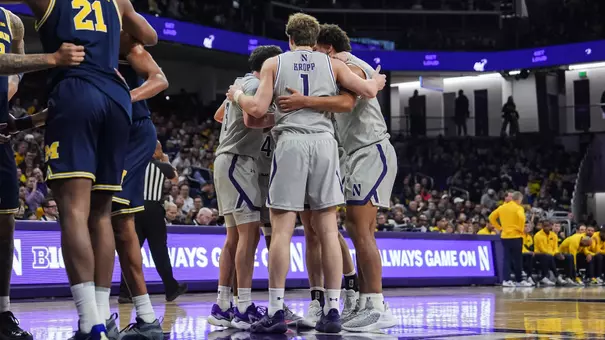
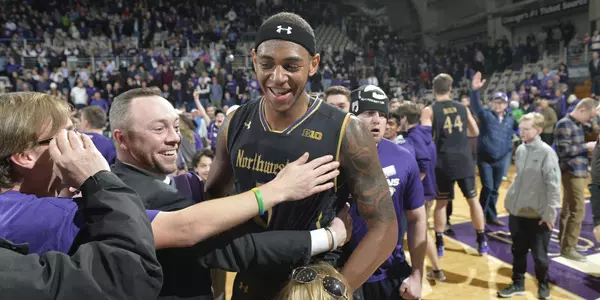
Pandemonium. As the ball passed through the basket, the Northwestern bench emptied. Pardon, pumping his fist, ran toward the center of the court and got taken down by Taphorn, Lindsey and Law. The student section followed shortly after, a mad rush of adrenaline and exhilaration pouring onto the hardwood floor.
George Ley, head usher: We always anticipate [a court rush]. As the season progresses and it's getting more exciting, we anticipate the last few games that the possibility exists. The first thing is, we try to stem the tide. If we can stop the first couple, maybe the tide ain't gonna flow. But when you see the tide's gonna go, it's all about safety — making sure people don't hurt themselves coming on.
Ross: One of the officials comes over to clarify that the call on the floor was that the basket was good. So I said something along those lines, and then when they determined that it was good, they came over and they blew the whistle and made the motion. And I was able to say, 'The basket is good, the final score..." It was a blast.
Ley: It was a last-second shot. It was reviewed. If they had said, no, there was a foul, there was a this or that, the floor has to be cleared, or Northwestern students — technically the bench — gets a technical foul.
Eanet: I never had any doubt in my mind that [Pardon] didn't get the shot up in time.
Ley: We position people at the spots where fans would generally come over. But honestly, when the team charged off the bench, it was over.
McIntosh: I first remember doing a Jordan-on-Ehlo jump. And then after that, my first thing was go find DP and tackle him.
Pardon: When I shot the ball and heard the buzzer go off, I don't know what I was doing. I just ran, and then all of a sudden I felt Scott [Lindsey] grab me, and all of a sudden I was on the ground. And after that it's just a blur.
Taphorn: I'll take blame for this, I was actually the guy that took Dererk down. I gave Dererk the biggest hug and felt the biggest rush behind us.
Baldwin: That's almost storybook. That's the type of stuff you make up when you're writing a book. To have it happen like that, it's unreal.
Ross: How could you top that?
Collins: It's almost kind of fitting. When you're trying to do things that are really hard, it takes exceptional things sometimes.
••••••
Be the first to know what's going on with the 'Cats -- Follow @NU_Sports on Twitter, become a fan of Northwestern Athletics on Facebook, check us out on Instagram, visit our Social Media page and download our mobile app from the Apple Store and Google Play! To get involved with the #B1GCats, become a season-ticket holder or join the Wildcat Fund!